Armenia 2017: Votes for Parties and for District Candidates Compared
Almost all votes for the ruling party came with a vote for a local candidate. Among voters who chose a party only, its share was half as large.
Original page on electionscount.info: Parties and individual candidates in the vote ratio, 2017Under the 2016 Electoral Code, an Armenian voter in 2017 received a ballot for each party. To vote, they put one party's ballot in the envelope; on the second page of that ballot they could also mark one of the party's candidates for their district. So every valid vote was either a party-only vote or a party-plus-candidate vote.
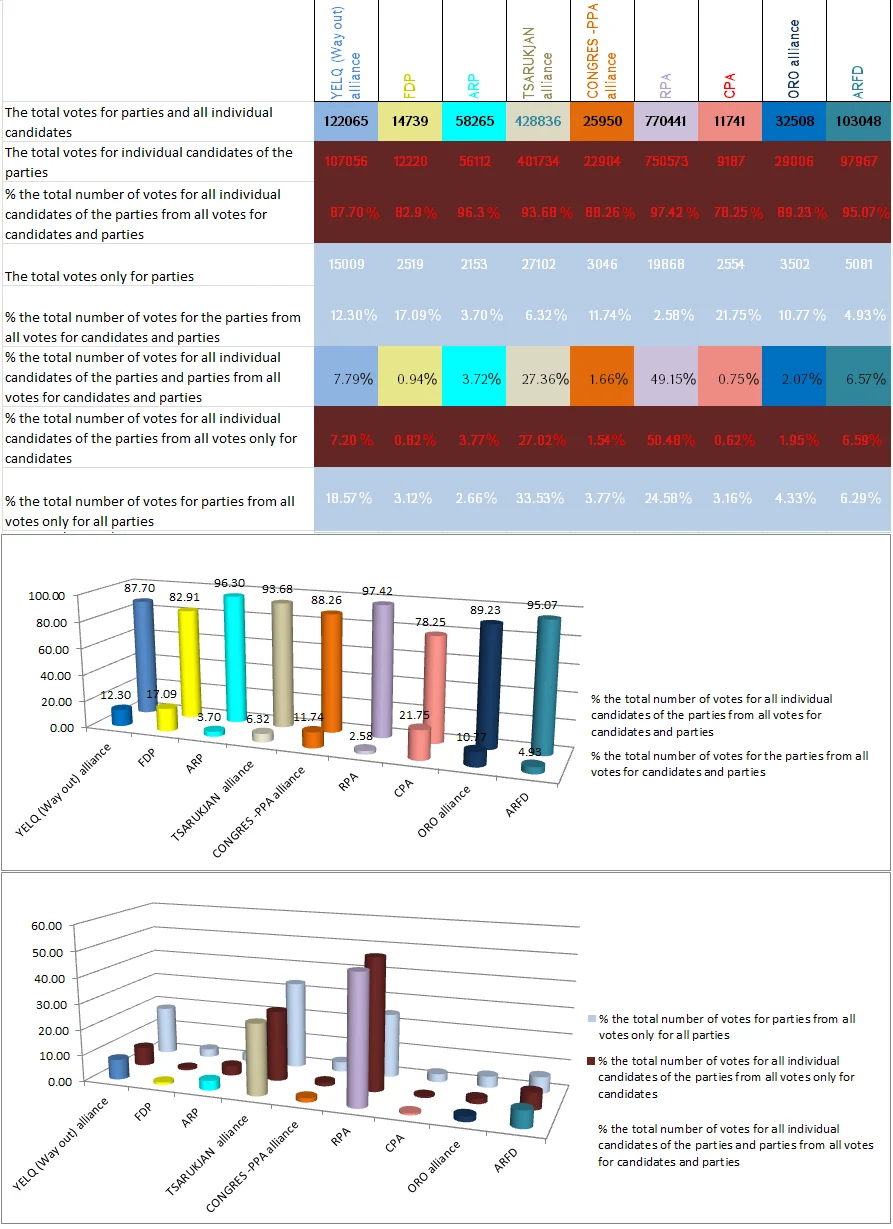
How to read this chart
The table at the top has one column per party. The first row is all its votes; the next rows split them into votes that also marked a district candidate and party-only votes. The middle chart shows that split for each party (tall bar = candidate votes, short bar = party-only). The bottom chart compares each party's share among all votes, among candidate votes and among party-only votes.
What it shows
- The Republican Party (RPA) got 770,441 votes, and 97.42% of them marked a district candidate. Only 19,868 were party-only.
- The Tsarukyan alliance: 428,836 votes, 93.68% with a candidate.
- The Yelk (Way Out) alliance: 122,065 votes, but 12.30% party-only, and the Free Democrats 17.09% party-only.
Of all 1,567,593 votes for the 9 parties, only 80,834, or 5.2%, were party-only. Among these voters the RPA had 24.58%, half its overall 49.15%; Yelk had 18.57%, more than twice its overall 7.79%; and Tsarukyan 33.53% against 27.36%.
Why the difference matters
Party-only votes come from voters who decided on a party without a local candidate. Candidate votes depend more on district candidates, who are often local businessmen or officials with their own networks. When a party's result rests almost entirely on candidate votes, as for the RPA and Tsarukyan in 2017, its success depends heavily on those local networks, the same networks that the monitoring and observers linked to vote-buying and pressure on voters.
The comparison does not prove fraud by itself. But it is a useful test: a party's share among the voters least exposed to local pressure is a cautious estimate of its free support. In 2018, after the change of government, the same test gave almost the same share for the winner in both groups, see the 2018 results.
Data and sources on this site
From the book
This article is based on Chapters I and II of Electoral Rights and Election Falsification by Lyudvig Khachatryan, which explains the full method, the formulas and the cases behind it.