Armenia 2013: The Voting Procedure in the Electoral Code and What It Means for the Numbers
Every step of the voting procedure leaves a count: signatures, stubs, envelopes and ballots. If the law was followed, they agree.
Original page on electionscount.info: Procedure for voting: articles from the Electoral CodeArmenia elected its president on 18 February 2013. Seven candidates stood; the incumbent Serzh Sargsyan (Republican Party) was declared the winner in the first round, and Raffi Hovannisian (Heritage) came second. The monitoring site for this election is at elections.transparency.am/2013.
The page “Procedure for voting” quotes the articles of the Electoral Code in force in 2013 that describe what happens inside a polling station. They matter for the analysis because every check on the site is a check of whether this procedure could have produced the reported numbers.
The steps, in order
- Entry (Article 63). No more than 15 voters may be in the voting room at the same time; the chair may admit them one by one. Military servicemen, national security officers and police troops “shall enter the polling station not in a marching order and without arms”.
- Registration (Article 64). Voting by proxy is prohibited. The registering member checks the voter’s identity document, finds the name in the list, writes the document details next to it; the voter signs; the member puts a personal seal next to the signature.
- Ballot (Article 65). Another member tears the stub off the ballot paper and gives the voter the ballot and an envelope.
- Booth and box (Article 66). The voter marks the ballot in the booth and puts it into the envelope. The member at the box checks that the identity document has no stamp for this election, stamps it with ink that lasts at least 12 hours, seals the envelope and lets the voter drop it into the box. A document that already carries the stamp means an attempt to vote twice: the ballot is cancelled and the police informed.
- Complaints. A commission member or proxy who sees a violation may have it recorded in the register.
What this means for the numbers
Each step leaves a count: signatures in the list, stubs torn off, envelopes in the box, ballots in the box. If the procedure was followed, the four counts are equal, and the unused ballots plus the used ones equal the ballots provided. That is exactly what the protocol checks test. The registration step also takes time: identity check, finding the name, writing the document number, signature, seal. This is the basis of the capacity limit of about 44 seconds per voter at one registration table.
Precincts with military voters
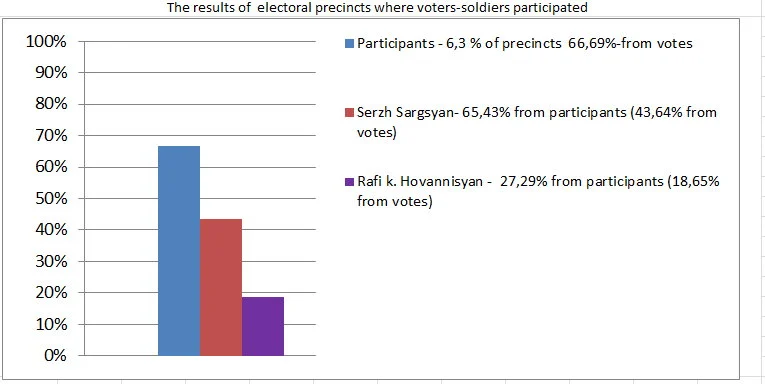
How to read this chart
Three bars, all as % of voters: participants (blue), Serzh Sargsyan (red), Raffi Hovannisian (purple). The labels give turnout and each candidate’s share of participants and, in brackets, of voters.
What it shows
The precincts where part of the voters were soldiers, 6.3% of all precincts, reported turnout of 66.69%, Sargsyan 65.43% of participants and Hovannisian 27.29%. In the country as a whole turnout was about 60% and Sargsyan’s share about 58.6%.
Soldiers vote in their unit’s precinct and are brought there together. The Code’s rule that they enter “not in a marching order” exists because voting in formation, under command, is not a free vote.
The full articles are on the page; the analysis of how these rules are broken in practice is the subject of the book.
Data and sources on this site
From the book
This article is based on Chapter VI of Electoral Rights and Election Falsification by Lyudvig Khachatryan, which explains the full method, the formulas and the cases behind it.