Armenia 2013: 638 Precincts Whose Protocols Do Not Add Up
Checking signatures, ballots and envelopes against each other finds mismatches at 638 precincts, totalling at least 3,027, four times the official inaccuracy of 743.
Original page on electionscount.info: Analysis of the results of voting, 2013Armenia elected its president on 18 February 2013. Seven candidates stood; the incumbent Serzh Sargsyan (Republican Party) was declared the winner in the first round, and Raffi Hovannisian (Heritage) came second. The monitoring site for this election is at elections.transparency.am/2013.
The page “Analysis of the results of voting” starts from a simple principle: the numbers in a precinct protocol must agree with each other, and a disagreement shows that the law was not followed at that precinct, even when it is too small to change the result. Its table checks the protocols of all 1,988 precincts.
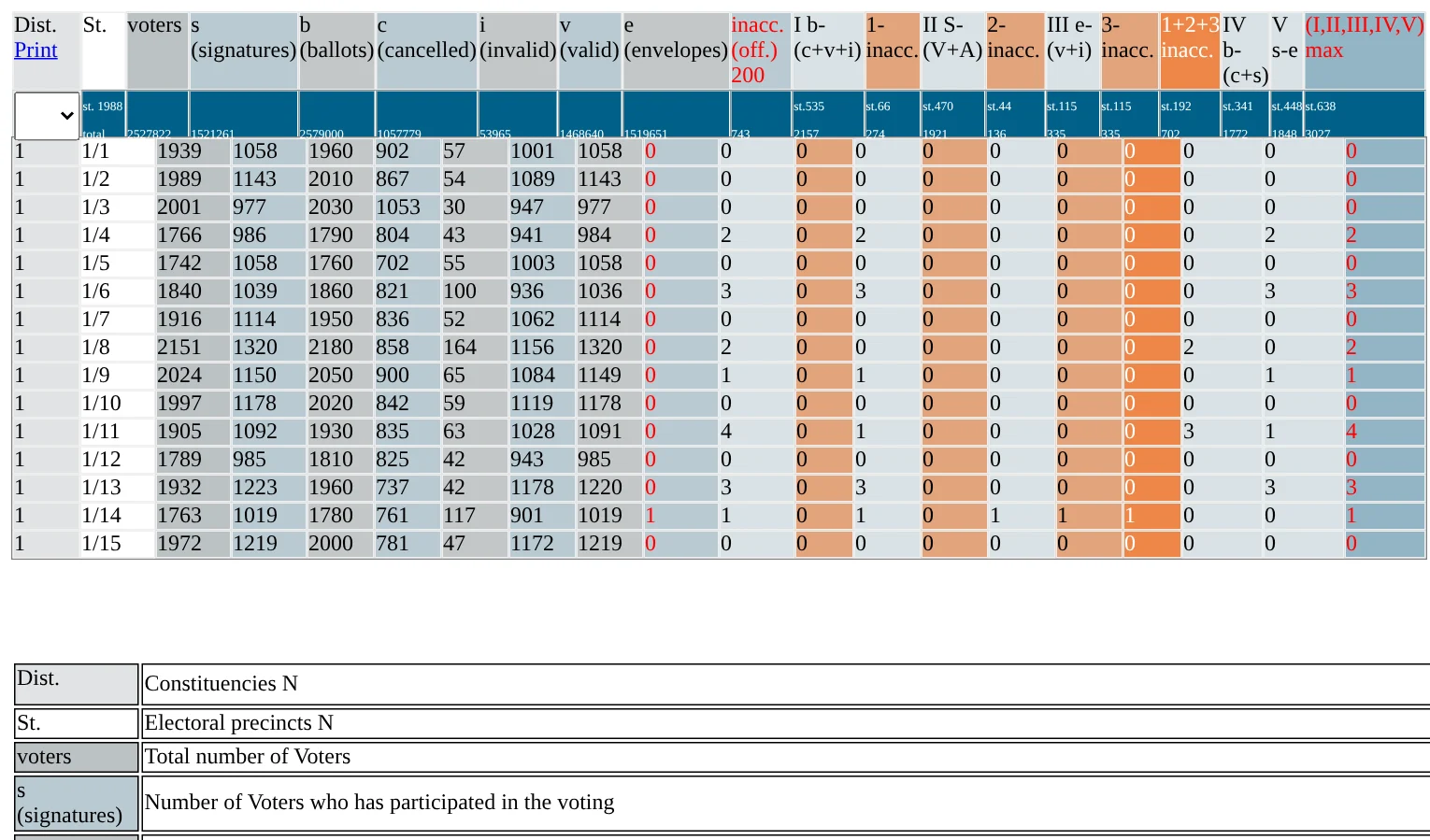
How to read this chart
- Dist., St.: constituency and precinct.
- voters; s signatures (participants); b ballots provided; c cancelled; i invalid; v valid; e envelopes in the box.
- inacc. (off.): the inaccuracy recorded by the commission.
- I–V: the five checks; 1-, 2-, 3-inacc. and 1+2+3: the inaccuracies as defined in the Electoral Code; max: the largest mismatch at the precinct.
- In the totals row “st.535 2157” means 535 precincts with a combined mismatch of 2,157.
What it shows
Totals: 2,527,822 voters, 1,521,261 signatures, 2,579,000 ballots, 1,057,779 cancelled, 1,468,640 valid and 1,519,651 envelopes. At the very first precincts in Yerevan, 1/21 has 702 signatures but only 626 ballots in the box, and 1/35 has 1,135 signatures and 1,076 ballots.
How to read this chart
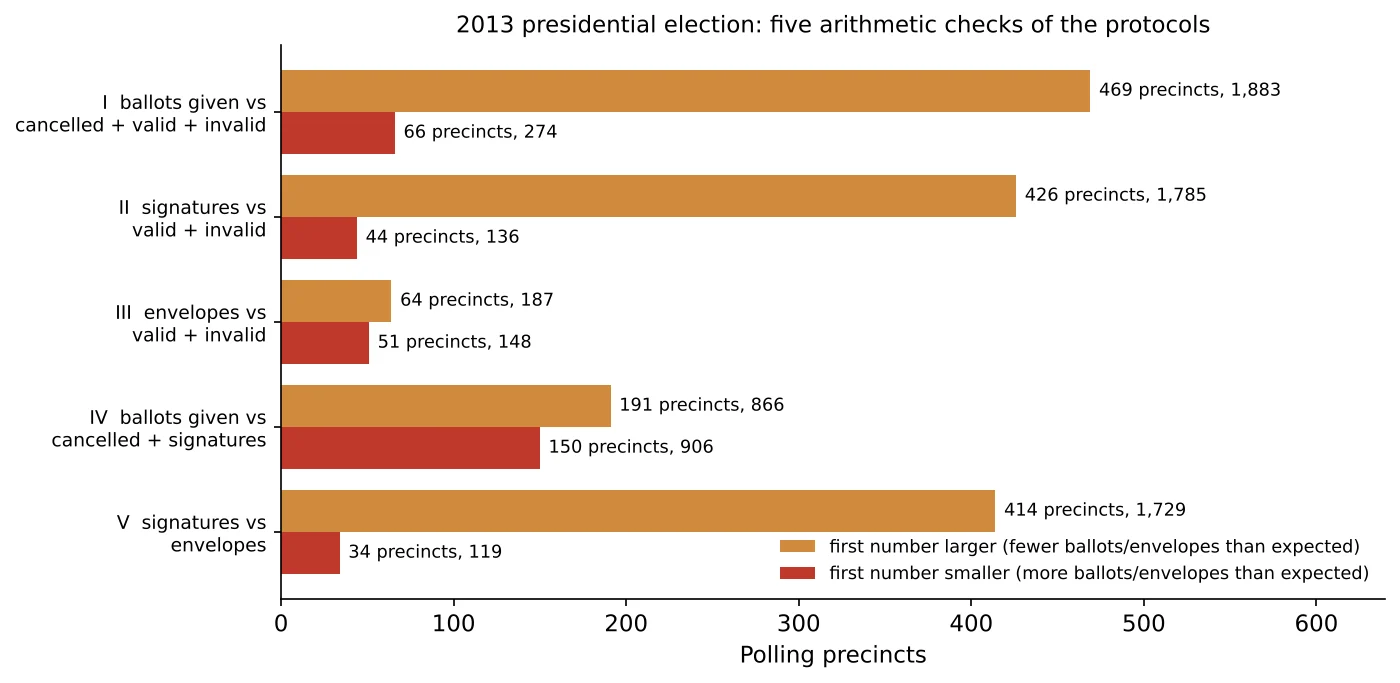
Each pair of bars is one check. Orange: the first number is larger than it should be (ballots or envelopes missing). Red: smaller (more ballots or envelopes than expected). Labels: precincts and total size.
What it shows
- I ballots provided vs cancelled + valid + invalid: 469 precincts missing 1,883 ballots; 66 with 274 extra.
- II signatures vs ballots in the box: 426 precincts with 1,785 more signatures; 44 with 136 more ballots.
- III envelopes vs ballots: 64 (+187) and 51 (−148).
- IV ballots provided vs cancelled + signatures: 191 (+866) and 150 (−906).
- V signatures vs envelopes: 414 (+1,729) and 34 (−119).
Taking the largest mismatch at each precinct, 638 precincts (32%) have protocols that do not add up, with a combined total of at least 3,027.
The official inaccuracy
The Electoral Code counts the first and second inaccuracies only when there are too many ballots in the box, and adds the larger of the two to the third. By that formula the protocol numbers give 702 at 192 precincts. The commissions recorded 743 at 200 precincts. Comparing the two precinct by precinct, they differ at 13 precincts: at nine of them the commission recorded an inaccuracy (up to 23, at 26/34) although its own numbers agree, and at four the recorded figure is different from what the numbers give (for example 37/4: 15 recorded, 21 by the formula; 32/1: 0 recorded, 5 by the formula). In 2015, by contrast, the commissions’ figures follow the formula at every polling station, as shown in the 2015 protocol checks.
Where and how large
Districts 1–13, Yerevan, have 222 of the 638 precincts with a mismatch: 47% of the city’s 469 precincts, against 27% elsewhere, and 1,320 of the 3,027. The largest single cases:
| Precinct | Signatures | Envelopes | Ballots in the box | Ballots provided − cancelled | Max |
|---|---|---|---|---|---|
| 30/20 | 971 | 902 | 912 | 990 | 78 |
| 1/21 | 702 | 626 | 626 | 626 | 76 |
| 13/8 | 1,167 | 1,098 | 1,099 | 1,099 | 69 |
| 1/35 | 1,135 | 1,076 | 1,076 | 1,135 | 59 |
| 29/50 | 184 | 184 | 184 | 228 | 44 |
At 29/50, a precinct of 222 voters, the commission received 228 ballots, cancelled none, and found 184 in the box: 44 ballots are unaccounted for.
Small errors on the page
- The totals row gives 53,965 invalid ballots; the rows of the table add up to 50,972. The checks in the table use the row figures.
- The explanation of check III says “355 in 115 precincts”; 187 + 148 = 335, the figure in the totals row.
The method is described in comparing election numbers; the procedure that produces these numbers is quoted in procedure for voting.
Data and sources on this site
From the book
This article is based on Chapter VI of Electoral Rights and Election Falsification by Lyudvig Khachatryan, which explains the full method, the formulas and the cases behind it.