Armenia 2015 Referendum: 614 Polling Stations Whose Protocol Numbers Do Not Add Up
Checking ballots, signatures and envelopes against each other finds mismatches at 614 polling stations, totalling at least 3,265, six times the official “inaccuracy” of 555.
Original page on electionscount.info: Voting results: mismatches between protocol numbers, 2015Every precinct commission writes its results into a protocol. The numbers in a protocol are linked: ballots handed to the commission must equal the ballots cancelled plus the ballots found in the box; the signatures in the voter list must equal the ballots in the box; the official envelopes in the box must match both. The page “Voting results: mismatches between protocol numbers” checks these links for each of the 1,997 polling stations of the 2015 referendum.
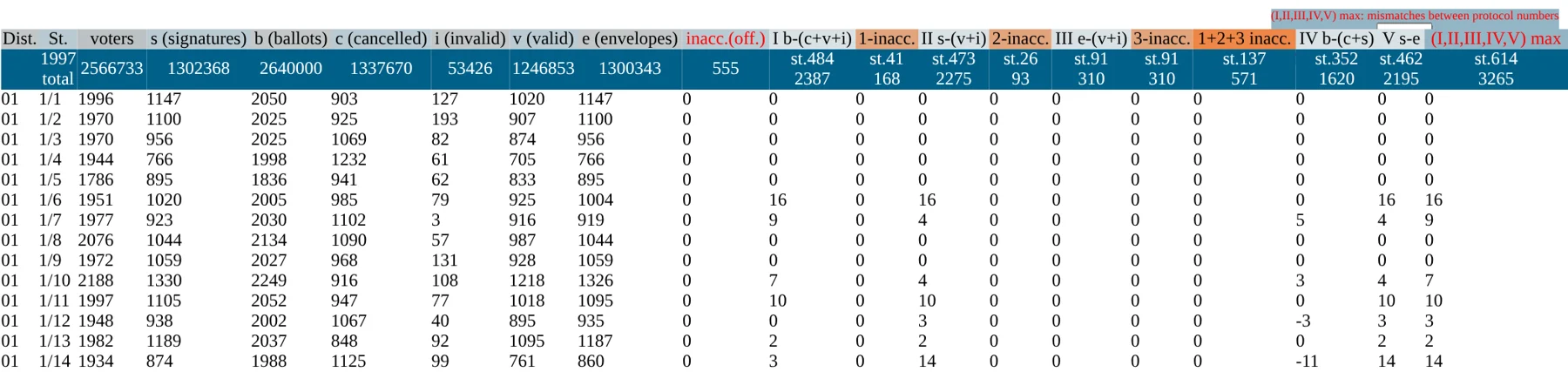
How to read this chart
- Dist., St.: electoral district and polling station.
- voters (ը.թ.): registered voters.
- s (ս): signatures in the voter list, that is participants.
- b (ք): ballots given to the commission.
- c (մ): cancelled (unused) ballots.
- i (ա) and v (վ): invalid and valid ballots found in the box.
- e (ծ): official envelopes found in the box.
- inacc. (off.): the “inaccuracy” that the commission itself recorded.
- I–V: the five checks described below; 1-, 2-, 3-inacc. and 1+2+3: the inaccuracies as the Electoral Code defines them; max: the largest of checks I, II, IV and V at the station.
- The top row gives totals; in the check columns “st.484 2387” means 484 stations with a total mismatch of 2,387.
What it shows
Totals for the whole country: 2,566,733 voters, 1,302,368 signatures, 2,640,000 ballots, 1,337,670 cancelled, 53,426 invalid, 1,246,853 valid and 1,300,343 envelopes. Already here, signatures (1,302,368) exceed the envelopes (1,300,343) and the ballots in the box (1,300,279).
The five checks
| Check | Should be equal | Stations: first number larger | Stations: first number smaller |
|---|---|---|---|
| I | ballots given = cancelled + valid + invalid | 443 (+2,219: ballots missing) | 41 (−168: extra ballots in the box) |
| II | signatures = valid + invalid | 447 (+2,182) | 26 (−93: more ballots than signatures, “stuffing”) |
| III | envelopes = valid + invalid | 48 (+187) | 43 (−123: more ballots than envelopes) |
| IV | ballots given = cancelled + signatures | 176 (+791) | 176 (−829) |
| V | signatures = envelopes | 439 (+2,110: envelopes taken out) | 23 (−85) |
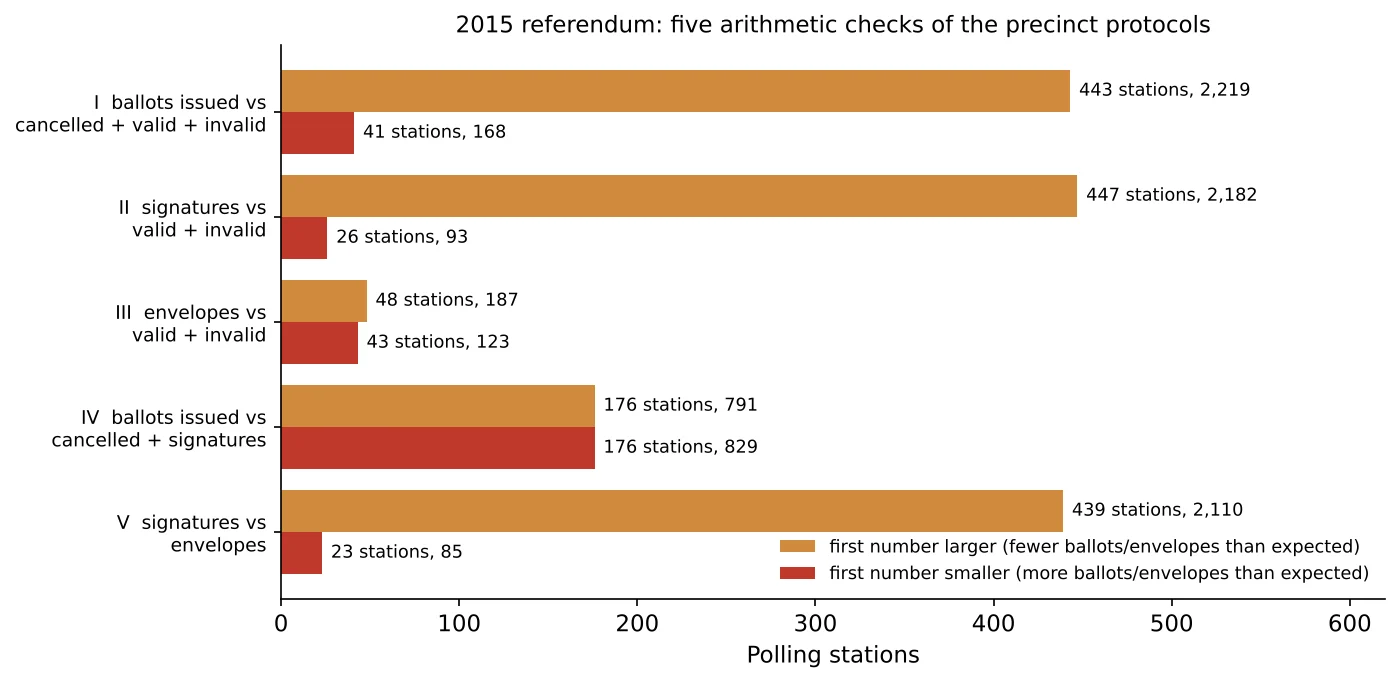
How to read this chart
Each pair of bars is one check. The orange bar counts the stations where the first number is larger than it should be, the red bar those where it is smaller. The label gives the stations and the total size of the mismatch, in ballots or signatures.
What it shows
Mismatches in one direction dominate. In checks I, II and V more than 400 stations recorded more signatures, or more ballots handed out, than ballots and envelopes found in the box. Check IV, which compares two numbers that both stay outside the box, is balanced: 176 stations each way.
When a station has more signatures than ballots in the box, either voters signed and left with their ballot, or signatures were added for people who did not vote and the ballots that should match them never reached the box.
The official “inaccuracy” is smaller
The Electoral Code defines three “inaccuracies” and adds them up in a particular way: the larger of the first two, plus the third. The page shows that exactly this formula gives the commission totals: 555 at 137 stations. The page’s own sum of the three, 1+2+3, is 571.
But the Code’s first and second inaccuracies only count a mismatch in one direction: more ballots in the box than there should be. Missing ballots and extra signatures are not counted at all. The page therefore takes, for each station, the largest of the four mismatches I, II, IV and V, in either direction. On that measure 614 stations (31%) have at least one mismatch, with a combined total of at least 3,265, six times the official figure.
Where the mismatches are
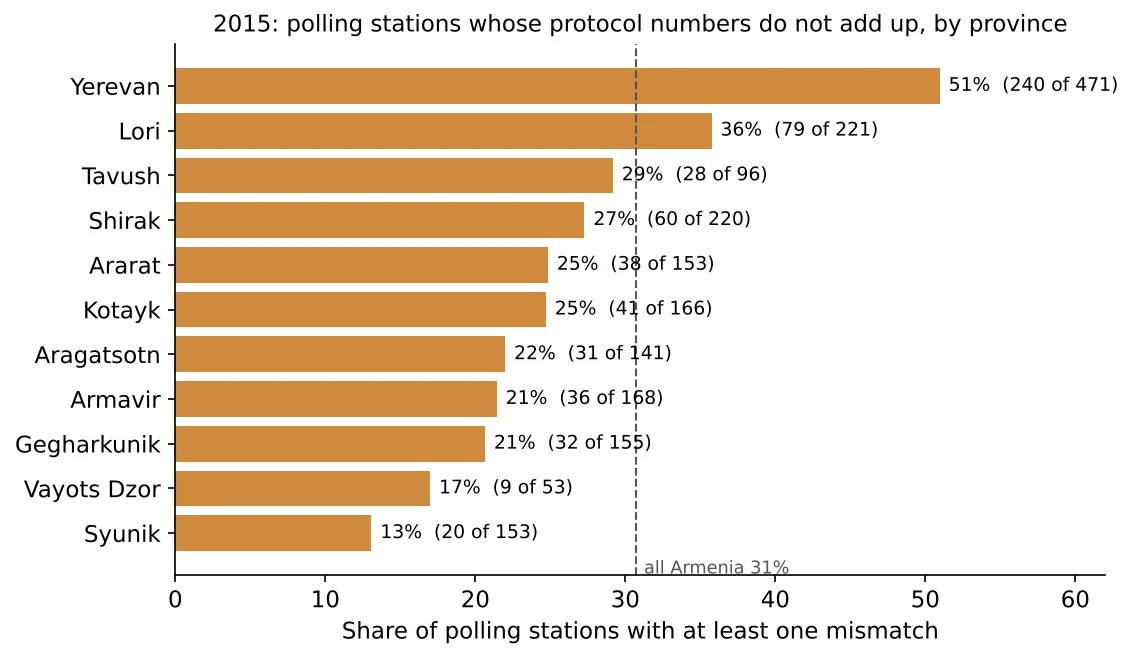
How to read this chart
Each bar is the share of the province’s polling stations whose protocol has a non-zero “max” value. The figures in brackets are the stations with a mismatch and all stations. The dashed line is the share for the whole country.
What it shows
Half of the stations in Yerevan (240 of 471) have a protocol that does not add up; Yerevan alone accounts for 1,527 of the 3,265. Lori (36%) and Shirak (27%) follow. In Syunik and Vayots Dzor fewer than one station in five has a mismatch.
Stations with a clean protocol reported higher turnout (52.2%) and more YES (67.0% of participants) than stations with a mismatch (48.3% turnout, 56.5% YES). A protocol whose numbers agree is not proof of an honest count: the numbers can be written to agree. The stations whose numbers do not agree are simply the ones where the commission did not, or could not, make them agree.
The largest mismatches
| Station | Community | Signatures | Envelopes | Ballots in the box | Max mismatch |
|---|---|---|---|---|---|
| 06/24 | Ajapnyak, Yerevan | 1,312 | 1,216 | 1,216 | 96 |
| 34/29 | Gyumri | 720 | 651 | 651 | 69 |
| 08/35 | Malatia-Sebastia, Yerevan | 744 | 686 | 680 | 64 |
| 19/48 | Parakar | 694 | 694 | 694 | 49 |
| 13/35 | Nubarashen, Yerevan | 1,034 | 988 | 988 | 46 |
At station 06/24, 96 people signed the list but neither their ballots nor their envelopes are in the box. At 19/48 signatures, envelopes and ballots agree, but 49 ballots are missing from the count of ballots given, cancelled and used.
A note on the page: the pop-up text for check V says “49 stations” with a positive difference of 2,110. The table itself gives 439 stations (462 − 23), so “49” is a typing error for 439.
The general method is explained in comparing election numbers; the same kind of check for 2012 is in the analysis of voting numbers, 2012.
Data and sources on this site
From the book
This article is based on Chapter VI of Electoral Rights and Election Falsification by Lyudvig Khachatryan, which explains the full method, the formulas and the cases behind it.