Armenia 2015 Referendum: Final Protocols vs the Turnout Published at 20:00
The final protocols show exactly 6,000 more participants than the CEC published at 20:00, when voting had already ended.
Original page on electionscount.info: Final results of the referendum by polling station, 2015At 20:00 on 6 December 2015, when the polling stations closed, the Central Electoral Commission published the number of participants at each station on elections.am. Later the precinct protocols gave the final number, the count of signatures in the voter list. The two numbers describe the same moment: after 20:00 nobody may vote. The page “Final results of the referendum by polling station” puts them side by side.
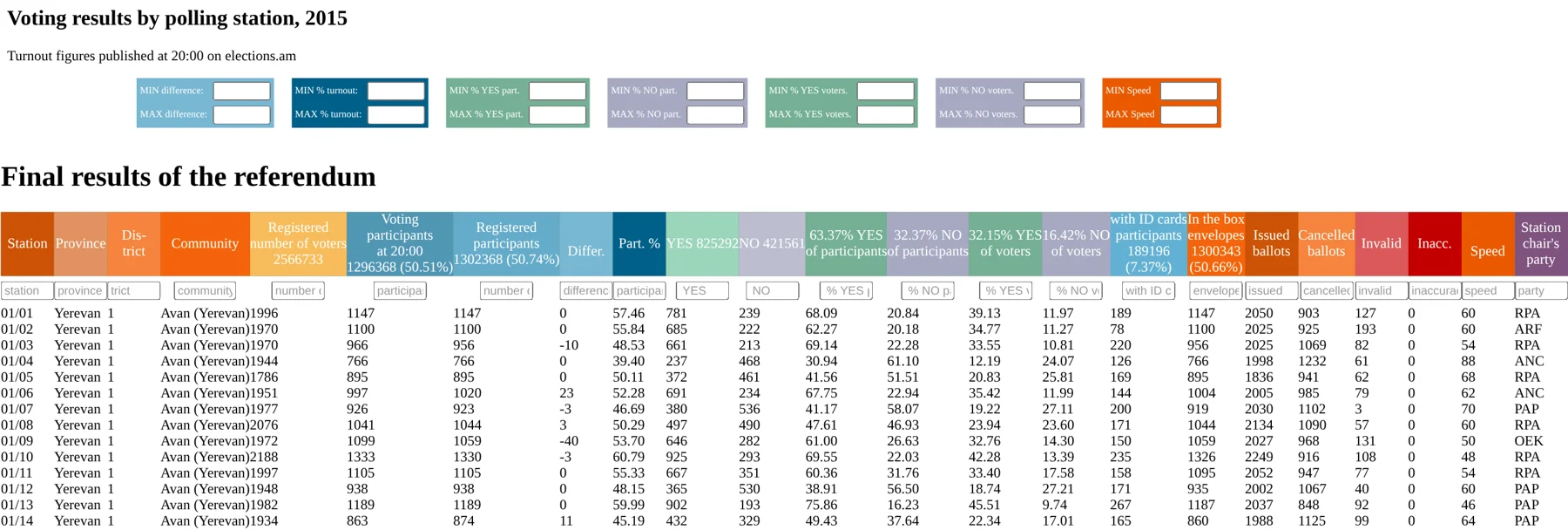
How to read this chart
- Registered number of voters: voters on the list (total 2,566,733).
- Voting participants at 20:00: the figure published at closing time (total 1,296,368, 50.51%).
- Registered participants: the final protocol figure (total 1,302,368, 50.74%).
- Differ.: final minus 20:00. A positive number means participants appeared after the polls closed; a negative number means some disappeared.
- YES, NO in votes, then as % of participants and as % of voters.
- with ID cards: participants who voted with an ID card rather than a passport (189,196, 7.37%).
- In the box envelopes, Issued, Cancelled, Invalid, Inacc.: other protocol numbers.
- Speed: the fastest average registration time in a 3-hour window, in seconds per voter (see stations above capacity).
- Station chair’s party. The fields above the table filter it by any column.
What it shows
The final national total is exactly 6,000 participants higher than the 20:00 figure: 1,302,368 against 1,296,368. At the first stations of Avan the two figures already differ by −40 to +23.
Where the numbers changed
In the current data, 1,344 stations reported the same number at 20:00 and in the protocol. At 407 stations the protocol has 8,839 more participants than were published at 20:00; at 246 stations it has 2,839 fewer. (The pop-up note on the page, written with an earlier version of the data, gives 664 stations, with 410 stations +9,677 and 254 stations −2,824; the net difference, 6,853 then and 6,000 now, has the same direction.)
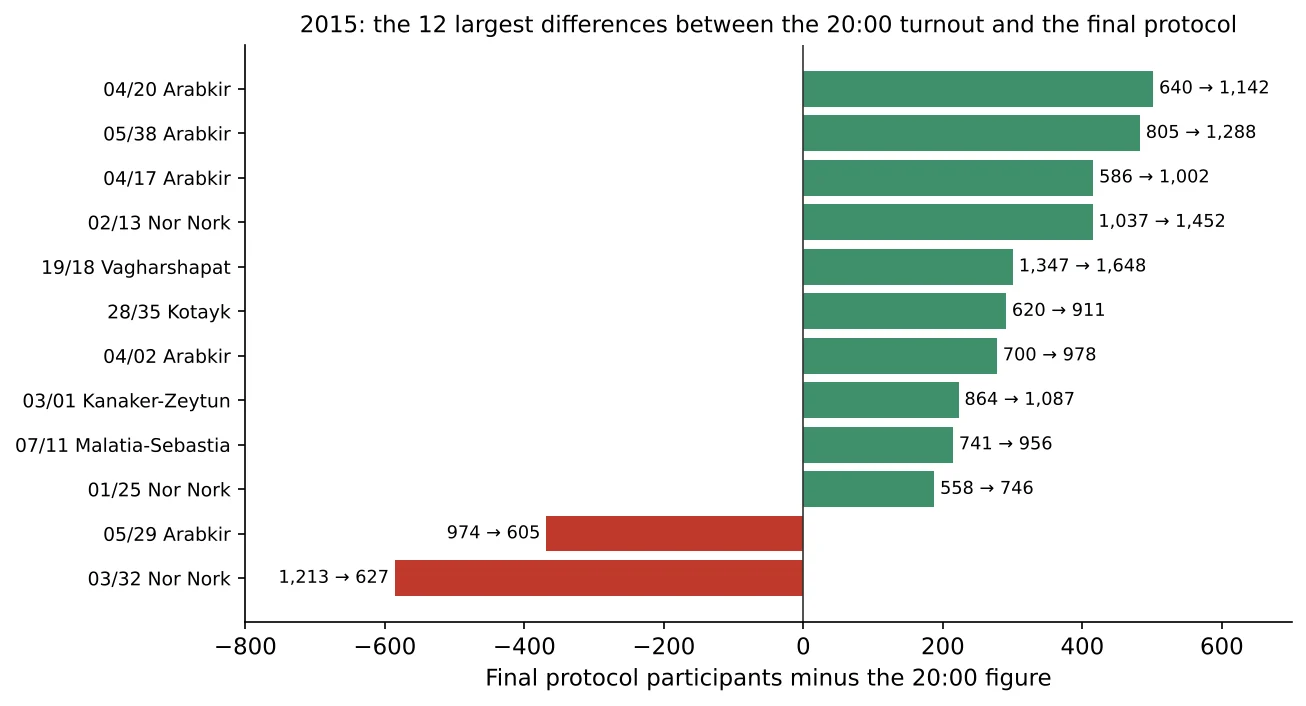
How to read this chart
Each bar is one polling station. Green bars grew after 20:00, red bars shrank. The label gives the 20:00 figure and the final figure.
What it shows
At station 04/20 in Arabkir, 640 participants were reported at 20:00 and 1,142 in the protocol, 502 more, a 78% increase after the polls had closed. Three more Arabkir stations and one in Nor Nork added 278 to 483 each. Two stations went the other way: 03/32 in Nor Nork fell from 1,213 to 627 and 05/29 in Arabkir from 974 to 605.
A difference of a few votes can be a typing slip. A station that “finds” 500 voters after closing time, or loses half of them, recorded at least one of its two numbers without counting.
Did the changes favour one side?
| Stations | Number | Turnout | YES, % of participants |
|---|---|---|---|
| Same number at 20:00 and in the protocol | 1,344 | 51.30% | 65.24% |
| Protocol higher than at 20:00 | 407 | 51.53% | 63.67% |
| Protocol lower than at 20:00 | 246 | 47.35% | 55.03% |
The changes are concentrated in Yerevan, where YES was weaker everywhere, so the table does not show by itself whom the added participants voted for. What it does show is that for 653 stations the CEC published two different answers to the question “how many people voted here?”, and that overall the answer grew by 6,000 after the polls closed.
How to use the page
Type a minimum in the MIN difference field, for example 50, to see only stations that added 50 or more participants after 20:00, or a maximum of −50 to see those that lost 50 or more. The same fields work for turnout, YES and NO, speed and the chair’s party. The other protocol checks for the same stations are in 614 stations whose numbers do not add up. For 2012 the same comparison is in voter numbers before and after election day.
Data and sources on this site
From the book
This article is based on Chapter VI of Electoral Rights and Election Falsification by Lyudvig Khachatryan, which explains the full method, the formulas and the cases behind it.