Armenia 2012: Mismatched Numbers at 1,436 of 1,982 Polling Stations
Ballots, signatures and envelopes failed to match at 1,436 of 1,982 polling stations. The law counted only 3,335 of the at least 17,889 doubtful ballots.
Original page on electionscount.info: Analysis of voting results, 2012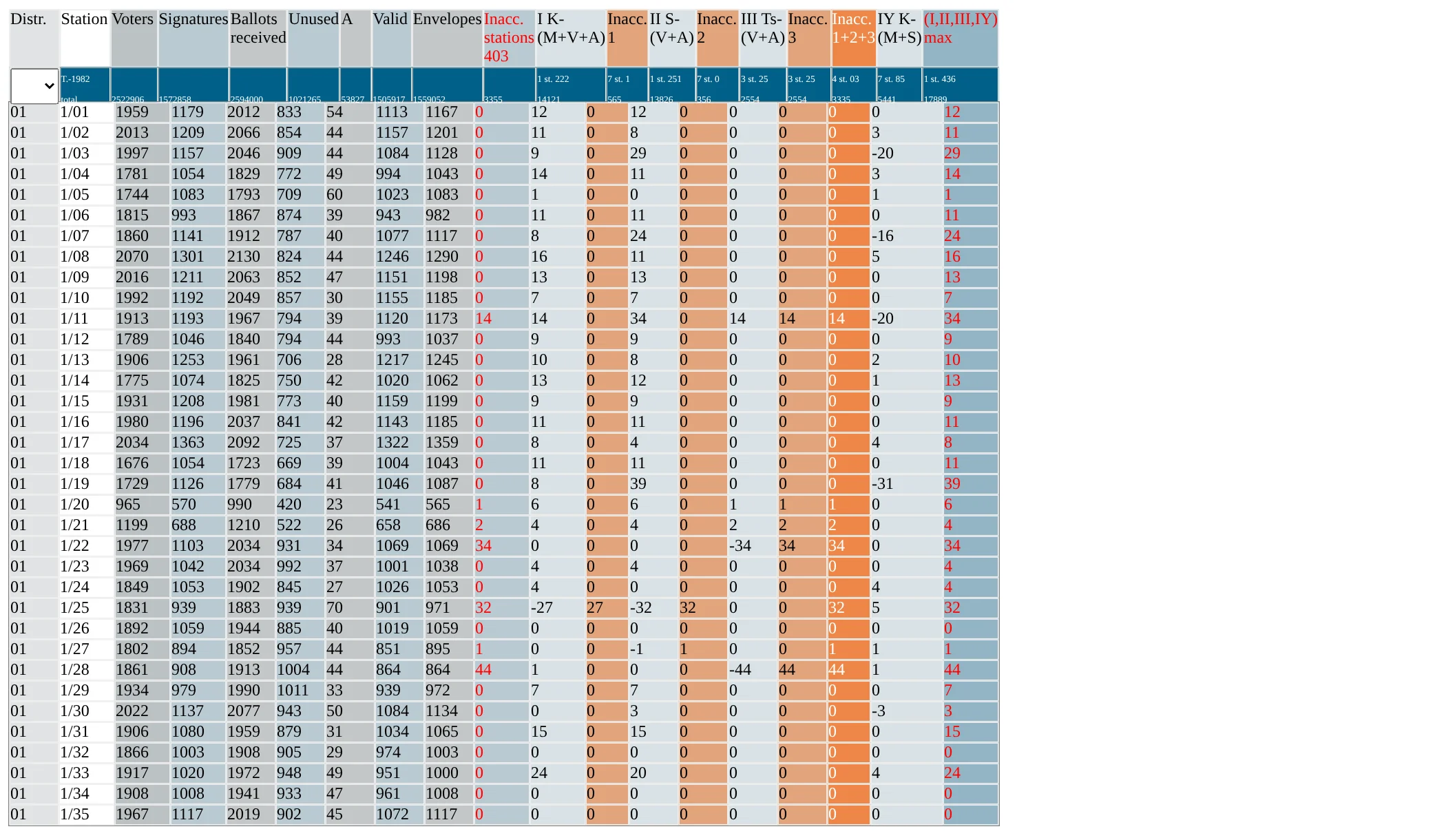
How to read this table
Each row is one polling station of territorial commission 01; choose another commission on the left. The first columns are the station's numbers from its protocol: voters, signatures (people who voted), ballots received, unused, invalid, valid and envelopes in the box. The coloured columns compare them in four ways (I–IV) and show the official inaccuracies; the last column is the largest mismatch at the station.
What it shows
In an honest count every comparison column is 0. In the first 35 stations of Yerevan almost none is: typical mismatches are 5–40 ballots per station, and station 1/28 has 44.
The four comparisons
| Check | What must be equal | Stations with a mismatch | Ballots in doubt |
|---|---|---|---|
| I | ballots received = unused + valid + invalid | 1,222 | 14,121 |
| II | signatures = valid + invalid ballots | 1,251 | 13,826 |
| III | envelopes = valid + invalid ballots | 325 | 2,554 |
| IV | ballots received = unused + signatures | 785 | 5,441 |
| Largest of the four, per station | 1,436 | 17,889 |
Check I shows 13,556 ballots missing at 1,151 stations (ballots received but neither unused nor in the box, so probably taken out, the "carousel") and 565 extra ballots at 71 stations (more in the box than were issued: stuffing). Check II shows 356 more ballots than signatures at 70 stations; at station 23/58 the box held 57 more ballots than there were signatures.
What the law counted
The Electoral Code of the time recognised only some of these comparisons as official "inaccuracies". By its rules there were 3,335 inaccuracies at 403 stations. The method finds at least 17,889 mismatched ballots at 1,436 stations, 1.14% of the 1,572,858 participants (the conclusions round it to 1.2%).
Article 125 of that Code said that if violations could have affected the result, the Central Electoral Commission must order a re-vote at the stations concerned, or declare the election invalid. The monitoring concluded that mismatches at so many stations, some of them proving stuffing, could only result from violations during the vote, and that the real results would have changed the distribution of mandates. The full method is in How to check an election with its own numbers.
The largest single mismatches were at stations 16/38 (131 ballots), 16/46 (118) and 12/36 (107).
Data and sources on this site
From the book
This article is based on Chapter VI of Electoral Rights and Election Falsification by Lyudvig Khachatryan, which explains the full method, the formulas and the cases behind it.