Armenia's Electoral Code, 2012–2026: How the Rule on Registration Tables Changed and What It Means for Voting Speed
Since 2016 the law has changed twice: one registering member per 1,000 voters until 2021, one per 1,200 from 2022, and one per 1,100 at the 2026 elections. Under the 2026 rule and our 44-second limit, 18 polling stations reported voting faster than one table can register people, not 8.
Original page on electionscount.info: Turnout and voting speed table, 2026Armenia's Electoral Code sets how many members of the precinct commission register voters at each polling station. Every voter must pass that registration table, so the rule decides how many people a station can serve in an hour, and therefore which official turnout reports are physically possible. The rule has changed twice since 2016.
What the law says and what we assume
This article combines two kinds of numbers. Some come from the law or from official data and can be checked in the sources. Others are assumptions of the method, chosen by us as data analysts; the law says nothing about them. The table marks which is which.
| What | Value | Where it comes from |
|---|---|---|
| Members registering voters | at least 1 per up to 1,000 voters (2016–2021), 1,200 (2022–2024), 1,100 (2026) | Law: Electoral Code, Article 64 |
| Parts of the voter list | up to 1,000, 1,200 or 1,100 voters per part | Law: Electoral Code, Article 11 |
| Voting booths | 1 per 750 voters (2016 Code), 1 per 600 (text in force) | Law: Electoral Code, Article 58 |
| Largest polling station | 2,000 voters (2016 Code), 2,200 (text in force) | Law: Electoral Code, Article 16 |
| Voters at 11:00, 14:00, 17:00 and 20:00 at each station | the reports as published | Official data: Central Electoral Commission (elections.am) |
| Shortest time to register one voter at one table | 44 seconds | Our assumption: an estimate of the method; the site's help page uses 45 seconds in its example |
| Number of tables at a station | the minimum the law requires: voters ÷ norm, rounded up | Our assumption: the law sets only a minimum; a station may use more |
| The step that limits the speed | registration only; booths and ballot box work in parallel | Our assumption: a simplification of the method |
| Speed in a 3-hour window | the average over the busiest 3 hours, with a steady flow of voters | Our assumption: the method; the reports give no finer timing |
| Stations left out | fewer than 100 voters, or a count that went down between reports | Our assumption: data cleaning by us |
| Rule for the 2015 referendum | 1 per up to 1,000 voters | Our assumption: the law text was not found; the site's 2015 table uses 1,000 |
Everything marked Law can be checked in the text of the Electoral Code. Everything marked Our assumption is a choice of the method: with a different value the counts change, as the next table shows.
How the result depends on our 44 seconds
Stations whose busiest 3 hours were faster than the limit, for different limits. The number of tables follows the law of each year; for 2026 both rules are shown.
| Limit, seconds per voter per table | 2015 | 2017 | 2018 | 2021 | 2026, 1,000 rule | 2026, 1,100 rule |
|---|---|---|---|---|---|---|
| 40 | 48 | 18 | 2 | 0 | 2 | 2 |
| 42 | 77 | 35 | 3 | 0 | 3 | 3 |
| 44 | 98 | 42 | 3 | 0 | 8 | 18 |
| 45 | 116 | 64 | 4 | 0 | 11 | 24 |
| 48 | 169 | 125 | 12 | 0 | 23 | 49 |
| 50 | 206 | 168 | 23 | 2 | 31 | 74 |
At 40 seconds, a very strict limit, 2 stations remain in 2026; at 45 seconds, the figure of the help page, 24. Whatever limit is chosen, 2015 and 2017 have far more stations near or below it than 2018, 2021 and 2026.
The rules, election by election
| Vote | Law in force | Members registering voters | Voter list split into parts of | Voting booths | Largest polling station at formation |
|---|---|---|---|---|---|
| 2012 and 2013 | Electoral Code of 2011 | at least 1 per up to 1,000 voters | — | 1 per 750 voters | — |
| 2015 referendum | Procedure before the 2016 Code | at least 1 per up to 1,000 voters | — | — | — |
| 2017, 2018 and 2021 | Electoral Code of 25 May 2016 | at least 1 per up to 1,000 voters | up to 1,000 voters | 1 per 750 voters | 2,000 voters |
| 2022–2024 (local elections from June 2021) | Law HO-202-N of 7 May 2021 | at least 1 per up to 1,200 voters | up to 1,200 voters | — | 2,000 voters |
| 2026 | Law HO-505-N of 5 December 2024 (text in force) | at least 1 per up to 1,100 voters | up to 1,100 voters | 1 per 600 voters | 2,200 voters |
Law HO-202-N raised the figure to 1,200 in May 2021, but for parliamentary elections it took effect only on 1 January 2022; for local elections, 30 days after its publication. The snap parliamentary elections of 20 June 2021 were therefore still held under the 1,000 rule. Law HO-505-N of 5 December 2024 set the figure at 1,100 and allowed polling stations of up to 2,200 voters; this is the text in force at the 2026 elections. For the 2015 referendum we found no rule different from 1,000, and the site's own 2015 table uses 1,000.
What the rule means for one polling station
This is our assumption, not the law: we take the shortest time to register one voter at one table to be about 44 seconds. One table can then register at most 10,800 ÷ 44 = 245 voters in 3 hours, and the number of tables, which the law does set, gives the most voters a station can report in its busiest 3 hours.
| Voters on the list | Tables, 1,000 rule | Most voters in 3 hours (our estimate) | Tables, 1,100 rule | Most voters in 3 hours (our estimate) |
|---|---|---|---|---|
| 900 | 1 | 245 | 1 | 245 |
| 1,050 | 2 | 490 | 1 | 245 |
| 1,100 | 2 | 490 | 1 | 245 |
| 1,500 | 2 | 490 | 2 | 490 |
| 2,050 | 3 | 736 | 2 | 490 |
| 2,200 | 3 | 736 | 2 | 490 |
The 2026 rule gives one table fewer to stations with 1,001–1,100 voters and to stations with 2,001–2,200 voters. For them, the most voters that can be registered in 3 hours falls by half or by a third.
How many polling stations are affected
| Year | Up to 1,000 voters | 1,001–1,100 | 1,101–2,000 | 2,001–2,200 | Over 2,200 |
|---|---|---|---|---|---|
| 2015 | 609 | 72 | 1,273 | 39 | 0 |
| 2017 | 609 | 67 | 1,295 | 38 | 0 |
| 2018 | 611 | 68 | 1,296 | 34 | 1 |
| 2021 | 615 | 62 | 1,270 | 60 | 1 |
| 2026 | 640 | 74 | 1,219 | 64 | 8 |
In 2026, 74 stations had 1,001–1,100 voters and 64 had 2,001–2,200: 138 stations where the law in force gives one table fewer than the old rule. The 8 stations with more than 2,200 voters got their extra voters after the polling stations were formed.
The 2026 elections recalculated
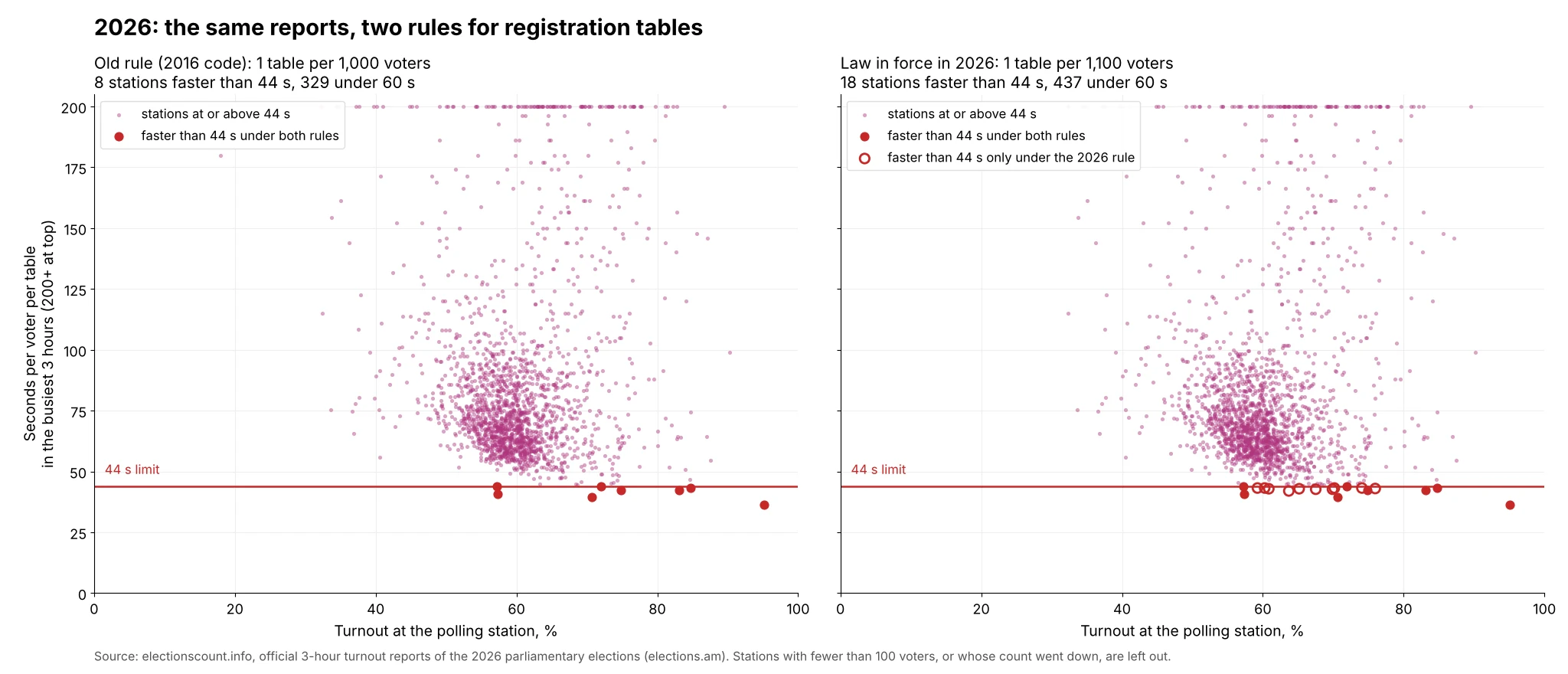
How to read this chart
Each dot is one polling station in the 2026 elections; both panels use the same official reports. Left to right: turnout. Bottom to top: seconds per voter per registration table in the station's busiest 3 hours. Filled red dots are below the 44-second line under both rules; open red circles are below it only when the 2026 rule is used.
What it shows
With one table per 1,000 voters, 8 stations were faster than 44 seconds. With one table per 1,100 voters, as the law required in 2026, 18 were. Nine of the ten new ones are stations of 1,001–1,100 voters that lose their second table; the tenth, with 2,030 voters, loses its third.
| Area | Stations | Faster than 44 s, 1,000 rule | Faster than 44 s, 1,100 rule | Under 60 s, 1,000 rule | Under 60 s, 1,100 rule | Typical seconds, 1,000 rule | Typical seconds, 1,100 rule |
|---|---|---|---|---|---|---|---|
| Armenia | 1948 | 8 | 18 | 329 | 437 | 73.5 | 70.1 |
| Yerevan | 475 | 1 | 2 | 142 | 167 | 63.9 | 62.8 |
| Aragatsotn Province | 129 | 0 | 0 | 18 | 22 | 88.9 | 87.4 |
| Ararat Province | 155 | 1 | 2 | 19 | 38 | 76.1 | 70.6 |
| Armavir Province | 168 | 0 | 0 | 11 | 23 | 78.0 | 73.1 |
| Gegharkunik Province | 150 | 2 | 3 | 18 | 19 | 77.0 | 76.8 |
| Kotayk Province | 167 | 0 | 1 | 37 | 52 | 71.1 | 65.1 |
| Lori Province | 214 | 1 | 3 | 24 | 34 | 76.3 | 74.5 |
| Shirak Province | 212 | 0 | 2 | 12 | 23 | 88.5 | 83.6 |
| Syunik and Vayots Dzor Provinces | 184 | 1 | 3 | 28 | 35 | 85.7 | 82.4 |
| Tavush Province | 94 | 2 | 2 | 20 | 24 | 72.8 | 71.3 |
For the whole country: 18 stations faster than 44 seconds instead of 8, 437 under 60 seconds instead of 329, and a typical speed of 70.1 seconds per voter per table instead of 73.5.
The 18 polling stations faster than 44 seconds in 2026
| Station | Area | Voters | Most in 3 hours | Tables | Seconds per voter per table, 2026 rule | Same, old rule |
|---|---|---|---|---|---|---|
| 10/51 | Yerevan | 1,355 | 596 | 2 | 36.2 | 36.2 |
| 35/37 | Syunik and Vayots Dzor Provinces | 988 | 273 | 1 | 39.6 | 39.6 |
| 25/45 | Lori Province | 961 | 265 | 1 | 40.8 | 40.8 |
| 33/20 | Shirak Province | 1,074 | 257 | 1 | 42.0 | 84.0 |
| 20/25 | Gegharkunik Province | 941 | 255 | 1 | 42.4 | 42.4 |
| 37/06 | Tavush Province | 963 | 255 | 1 | 42.4 | 42.4 |
| 22/34 | Lori Province | 1,065 | 253 | 1 | 42.7 | 85.4 |
| 36/18 | Syunik and Vayots Dzor Provinces | 1,086 | 253 | 1 | 42.7 | 85.4 |
| 33/43 | Shirak Province | 1,014 | 252 | 1 | 42.9 | 85.7 |
| 34/12 | Syunik and Vayots Dzor Provinces | 1,082 | 252 | 1 | 42.9 | 85.7 |
| 28/14 | Kotayk Province | 2,030 | 502 | 2 | 43.0 | 64.5 |
| 6/11 | Yerevan | 1,099 | 250 | 1 | 43.2 | 86.4 |
| 11/17 | Ararat Province | 1,002 | 250 | 1 | 43.2 | 86.4 |
| 21/40 | Gegharkunik Province | 1,004 | 250 | 1 | 43.2 | 86.4 |
| 25/31 | Lori Province | 1,022 | 250 | 1 | 43.2 | 86.4 |
| 38/31 | Tavush Province | 922 | 249 | 1 | 43.4 | 43.4 |
| 12/44 | Ararat Province | 913 | 246 | 1 | 43.9 | 43.9 |
| 21/34 | Gegharkunik Province | 988 | 246 | 1 | 43.9 | 43.9 |
Most of them reported between 246 and 257 voters in their busiest 3 hours: just above the 245 voters that one table can register in that time. Stations 10/51 in Yerevan, 35/37 in Syunik and 25/45 in Lori are below the line under either rule.
What this means for the 2015–2026 series
The articles turnout and voting speed 2015–2026 use the same rule as this article: the number of tables the law required at the time of each vote, one per 1,000 voters for 2015–2021 and one per 1,100 for 2026. Their 2026 figures match the right-hand panel of the chart above.
The law sets a minimum. A commission may assign more registration members than the law requires. A station that really worked with more tables could register people faster than these figures assume, so every station below the line needs checking, not a verdict.
Where the law texts come from
The current text of the Electoral Code with its history of amendments is on ARLIS, the official legal information system of Armenia; the 2021 amending law and its entry-into-force article are here; the Code as adopted in 2016 is available in English; and the rule of the 2012 elections is in the Central Electoral Commission's guide for precinct commissions.
Data and sources on this site
From the book
This article is based on Chapter VI of Electoral Rights and Election Falsification by Lyudvig Khachatryan, which explains the full method, the formulas and the cases behind it.