Armenia 2017: Turnout and Voting Speed at All 2,009 Polling Stations
The 2017 election had the highest turnout of the three, 60.86%, and the most stations close to capacity.
Original page on electionscount.info: Turnout and voting speed table, 2017On 2 April 2017, 2,009 polling stations had 2,587,707 registered voters and 1,574,947 participants, a turnout of 60.86%. By 3-hour window: 344,714 voted before 11:00, 521,170 between 11:00 and 14:00, 452,052 between 14:00 and 17:00 and 257,011 after 17:00.
The 2017 election had the highest turnout of the three, 60.86%, and the most stations close to capacity: 1,529 of 2,009 stations registered voters faster than 60 seconds per voter per table, and 42 faster than the 44-second limit. Many of those 42 are villages that also reported very high turnout, such as Aravus in Syunik (92.81%) and Kajaran (83.84%).
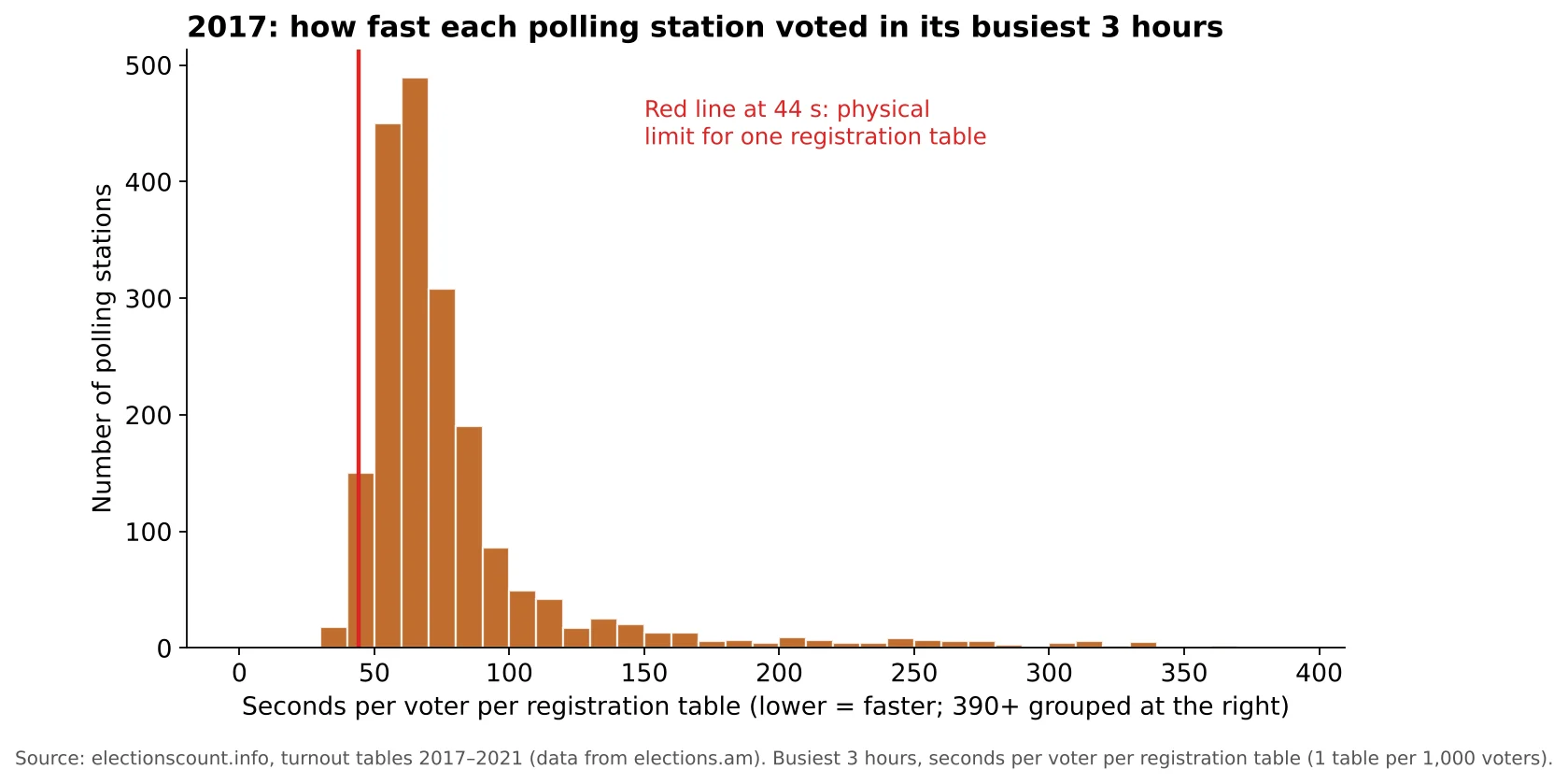
How to read this chart
Each bar counts the polling stations whose busiest 3 hours fell in a 10-second range. Left = fast, right = slow. The red line is the 44-second limit for one registration table.
What it shows
618 stations were faster than 60 seconds and 42 faster than 44. The bulk of stations sits just to the right of the line, and a tail crosses it.
Stations above physical capacity
| Station | Community | Voters | Turnout | Most in 3 hours | Tables | Seconds per voter per table |
|---|---|---|---|---|---|---|
| 36/15 | Yelpin | 986 | 74.75% | 320 | 1 | 33.8 |
| 17/22 | Ohanavan | 1,952 | 77.0% | 593 | 2 | 36.4 |
| 34/43 | Aravus | 946 | 92.81% | 291 | 1 | 37.1 |
| 13/32 | Ararat | 1,930 | 70.67% | 580 | 2 | 37.2 |
| 8/31 | Shengavit | 1,966 | 63.22% | 576 | 2 | 37.5 |
| 35/56 | Kajaran (town) | 1,887 | 83.84% | 573 | 2 | 37.7 |
| 33/22 | Meghrashen | 935 | 74.97% | 285 | 1 | 37.9 |
| 2/05 | Nor Nork | 1,629 | 85.94% | 566 | 2 | 38.2 |
| 11/45 | Jrahovit | 975 | 74.46% | 283 | 1 | 38.2 |
| 27/24 | Fantan | 805 | 74.41% | 282 | 1 | 38.3 |
| 20/15 | Tsaghkunk | 778 | 73.26% | 279 | 1 | 38.7 |
| 10/51 | Nubarashen | 936 | 79.17% | 278 | 1 | 38.9 |
| 12/31 | Narek | 900 | 79.56% | 277 | 1 | 39.0 |
| 26/37 | Aghavnadzor | 991 | 68.92% | 277 | 1 | 39.0 |
| 37/30 | Sarigyugh | 994 | 72.43% | 277 | 1 | 39.0 |
| 19/23 | Gavar (town) | 1,980 | 71.11% | 553 | 2 | 39.1 |
| 30/54 | Haykavan | 971 | 68.69% | 274 | 1 | 39.4 |
| 18/06 | Aruch | 876 | 76.26% | 273 | 1 | 39.6 |
| 25/39 | Agarak | 975 | 65.33% | 270 | 1 | 40.0 |
| 19/05 | Tsovazard | 1,621 | 75.2% | 535 | 2 | 40.4 |
The table shows the 20 fastest of 42.
Counts that went down
At 2 stations a later report showed fewer voters than an earlier one: 2/49 Nor Nork (240, 300, 440, -61); 13/51 Kaghtsrashen (190, 267, 405, -93). The four numbers are the voters in each 3-hour window; a negative number is impossible in a real count. See all such cases.
The capacity rule used here. Registering one voter at one table, checking the ID and handing out the ballot and envelope takes at least about 44 seconds. The Electoral Code (Article 64) gives each polling station at least one registration member per 1,000 voters, so a station with up to 1,000 voters is counted as having one table, up to 2,000 voters two tables. The "seconds per voter per table" figure is the station's fastest 3-hour average multiplied by its number of tables. Below 44 seconds, the reported turnout is faster than the station could physically register people.
Original turnout reports for 2017, as downloaded from elections.am: 11:00, 14:00, 17:00, 20:00.
Data and sources on this site
From the book
This article is based on Chapter VI of Electoral Rights and Election Falsification by Lyudvig Khachatryan, which explains the full method, the formulas and the cases behind it.