Armenia 1995–1996: The First Parliamentary Law and the Elections That Followed
In the rating vote on electoral systems, a multi-member majoritarian draft won more than 70 votes against about 40, yet only the other draft was put forward.
Original page on electionscount.info: The Electoral Rights and Falsifications of Elections (2010, PDF), p. 37The chapter on elections up to 1999 opens with the debate in the Supreme Council on the law for the first parliament of independent Armenia. Two drafts competed: one combining single-member majoritarian districts with proportional party lists, the other a multi-member majoritarian system in which voters elect several candidates per district.
According to the book, in the rating vote the second draft received more than 70 votes and the first about 40. Even so, only the first draft was left for discussion: the leaders of both the ruling and the opposition parties, whose interests coincided on this point, supported it, and the second draft was given ten minutes for a presentation. The author’s explanation is direct: a multi-member majoritarian system “did not suit the majority of deputies”, because it would have made them depend on voters rather than on party leaders.
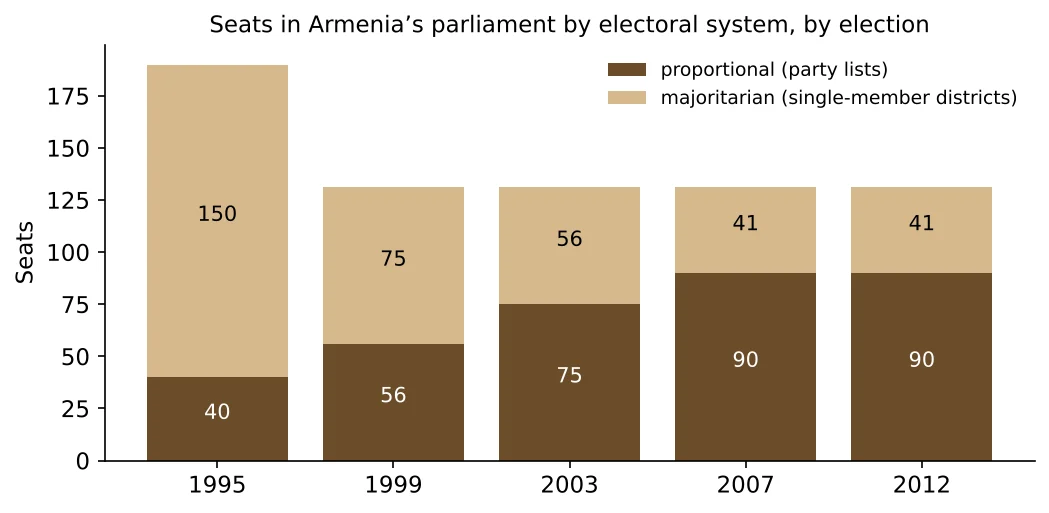
How to read this chart
Each bar is one parliamentary election. The dark part is the seats distributed between party lists in proportion to their votes; the light part is the seats won in single-member districts by whoever came first.
What it shows
The 1995 parliament had 190 seats: 150 from single-member districts and 40 from party lists. From 1999 the parliament shrank to 131 seats and the balance gradually shifted towards party lists: 56 in 1999, 75 in 2003, 90 from 2007.
The 1995 and 1996 elections
The parliamentary elections of 1995 were held under the mixed law; the presidential election followed in 1996. The book’s judgement on both is that the composition of power was decided “not by the votes of the voters, but by the will of the authorities, through decisions of the commissions”, although in the parliamentary election the voters’ choice was, for the most part, taken into account.
The point the book draws from this period recurs in every later chapter: an electoral system is chosen by those who will be elected under it, and the choice follows their interests. The analysis of numbers that the book develops for 2003–2009 starts here, with the question of who the system makes the elected answerable to.
Next: 1998–1999; the method used for later elections: comparing election numbers.
Source: “The Electoral Rights and Falsifications of Elections” (2010, in Armenian), the earlier Armenian book by the same author, which analyses the officially published figures of each election. The figures here are taken from it; page numbers refer to the PDF.
Data and sources on this site
From the book
This article is based on the 2010 Armenian edition of Electoral Rights and Election Falsification by Lyudvig Khachatryan, which explains the full method, the formulas and the cases behind it.