Armenia 1998–1999: A New Electoral Code, a Snap Presidential Election and a New Parliament
In 1998 a candidate was elected president although, the book argues, the ten-year residency rule of the Constitution barred him from standing.
Original page on electionscount.info: The Electoral Rights and Falsifications of Elections (2010, PDF), p. 37After the resignation of the president in 1998, together with the speaker and the government, many deputies changed party. The book’s summary: “some of the people in power had changed, the system had not.” A new Electoral Code was adopted, but the electoral system was kept.
The rules of the new code
- 131 deputies: 56 from national party lists in proportion to their votes, 75 from single-member districts by relative majority.
- Seats went to parties with more than 5% of valid votes; a list needed the support of at least 30,000 voters’ signatures.
- Seats were divided in proportion to votes, remainders one by one to the largest remainders.
- District candidates were nominated by parties or by 50 voters, supported by at least 500 signatures.
- Central and regional commissions: three members appointed by the government, one from each parliamentary group, and one from each of the five non-parliamentary parties that collected the most signatures; precinct members were appointed one each by the members of the regional commission, who could also recall them.
- Voter lists were compiled by community heads from residence registration.
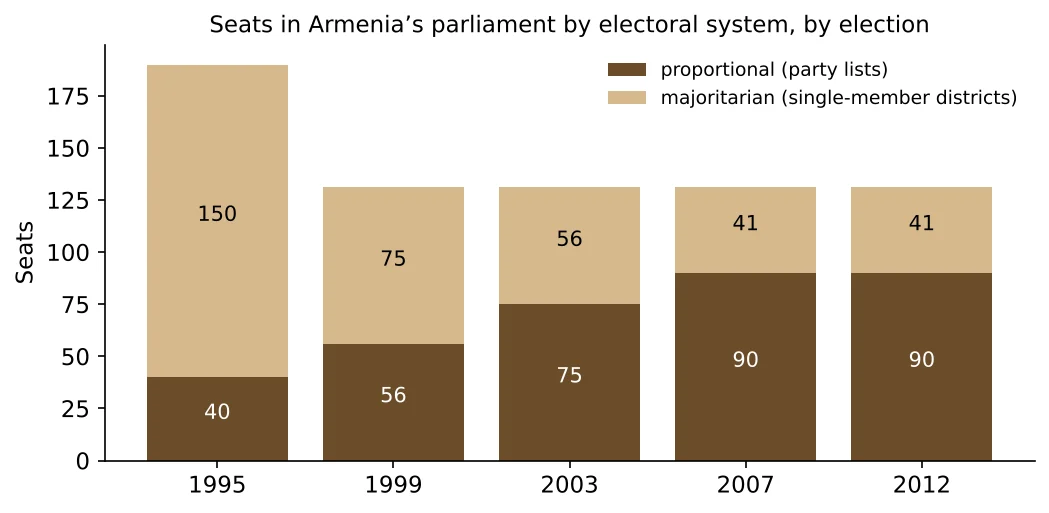
How to read this chart
Each bar is one parliamentary election. The dark part is the seats distributed between party lists in proportion to their votes; the light part is the seats won in single-member districts by whoever came first.
What it shows
The 1999 code moved from 40/150 to 56 party-list and 75 district seats in a smaller, 131-member parliament.
The 1998 presidential election
The snap presidential election of 1998 was, in the book’s words, held “with falsifications and, most importantly, in breach of a constitutional norm”. Article 50 of the Constitution allowed anyone to be elected who had been a citizen of Armenia and permanently resident in it for the previous ten years. The winner had for at least six of those years been president of an internationally unrecognised state and, the author argues, could not have been permanently resident in Armenia. The candidacy was accepted with the consent of much of the political elite, including competing candidates, and confirmed by a court.
The 1999 parliament
“To say that it was without falsifications would be unconscionable, but the voters’ votes were taken into account more.” On 27 October 1999 the speaker and the prime minister were killed in the terrorist attack on parliament; the government changed and many deputies again changed party.
Previous: 1995–1996. Next: the 2002 code.
Source: “The Electoral Rights and Falsifications of Elections” (2010, in Armenian), the earlier Armenian book by the same author, which analyses the officially published figures of each election. The figures here are taken from it; page numbers refer to the PDF.
Data and sources on this site
From the book
This article is based on the 2010 Armenian edition of Electoral Rights and Election Falsification by Lyudvig Khachatryan, which explains the full method, the formulas and the cases behind it.