Armenia 2003 Presidential Election: Turnout That Fell After the Polls Closed
After voting ended, the reported turnout in Yerevan’s Avan district fell from 62.44% to 56.86%. Participants cannot disappear once they have voted.
Original page on electionscount.info: The Electoral Rights and Falsifications of Elections (2010, PDF), p. 40The book’s analysis of 2003 starts from figures that need no observers to check: the numbers the Central Electoral Commission itself published. Even without the many reported violations, it says, “a simple arithmetic analysis of the officially published results raises deep doubt”.
Turnout that went down
- First round, Avan district (Yerevan): turnout before the end of voting 62.44%, after the end 56.86%.
- Erebuni district: 62.89% → 62.51%.
- Second round, Gegharkunik province: 71.63% → 71.43%; Sevan: 76.59% → 71.38%.
A count of people who have voted can only grow during the day. A fall after the polls close means that the earlier, published number was not a count.
Neighbouring stations that disagreed
Of the 190 polling stations that shared a building with at least one other station (94 addresses), many showed different turnout although their voters live in the same streets: a gap of more than 10% at no fewer than 60 addresses in the first round and 80 in the second, and of more than 5% at 107 and 145 addresses.
Very high turnout
- 100% turnout at 7 stations in the first round.
- More than 90% at 96 stations in the first round and 147 in the second.
- More than 80% at 305 and 455.
The book also points out that the turnout announced for certain hours was physically impossible: across the country, the number of participants in a few hours could not exceed, two or three times over, what all polling stations together could register. This is the capacity argument developed later in polling station capacity.
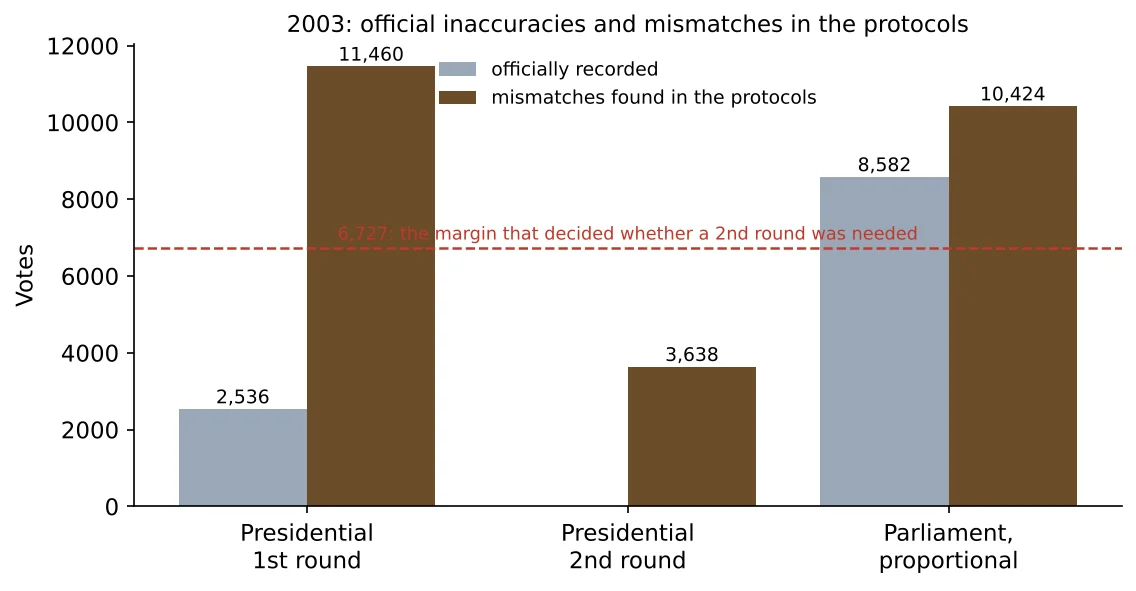
How to read this chart
Grey: the inaccuracies the commissions officially recorded. Brown: the mismatches between protocol numbers that the author counted station by station. The dashed line is 6,727, explained in the first-round article.
What it shows
In every 2003 vote the protocols contain far more mismatches than the commissions recorded: 11,460 at 435 stations in the first round, against an official 2,536.
Source: “The Electoral Rights and Falsifications of Elections” (2010, in Armenian), the earlier Armenian book by the same author, which analyses the officially published figures of each election. The figures here are taken from it; page numbers refer to the PDF.
Data and sources on this site
From the book
This article is based on the 2010 Armenian edition of Electoral Rights and Election Falsification by Lyudvig Khachatryan, which explains the full method, the formulas and the cases behind it.