Armenia 2003 Presidential Run-off: 13,500 More Voters, 132,200 More Participants
Between the two rounds the voter list grew by 0.6%, while the number of participants grew by about 10%.
Original page on electionscount.info: The Electoral Rights and Falsifications of Elections (2010, PDF), p. 41The two leading candidates met in a second round two weeks after the first. The book compares the two rounds station by station.
Lists and turnout between the rounds
- The total number of voters increased by more than 13,500, about 0.6%.
- The number of participants increased by more than 132,200, about 10%.
- In the absolute majority of stations the voter numbers changed between the rounds.
- The voter and participant numbers of the referendum held at the same time as the parliamentary election in 2003 did not match those of the election.
Mismatches in the run-off
- Mismatches between ballots issued and used: 226 stations, more than 1,574.
- Ballots in the box above signatures: 72 stations, 1,816.
- Total inaccuracies by station: 3,638 at 313 stations.
Turnout above 90% was reported at 147 stations and above 80% at 455, against 96 and 305 in the first round. In Sevan, the reported turnout fell from 76.59% to 71.38% after the polls closed, see turnout that fell.
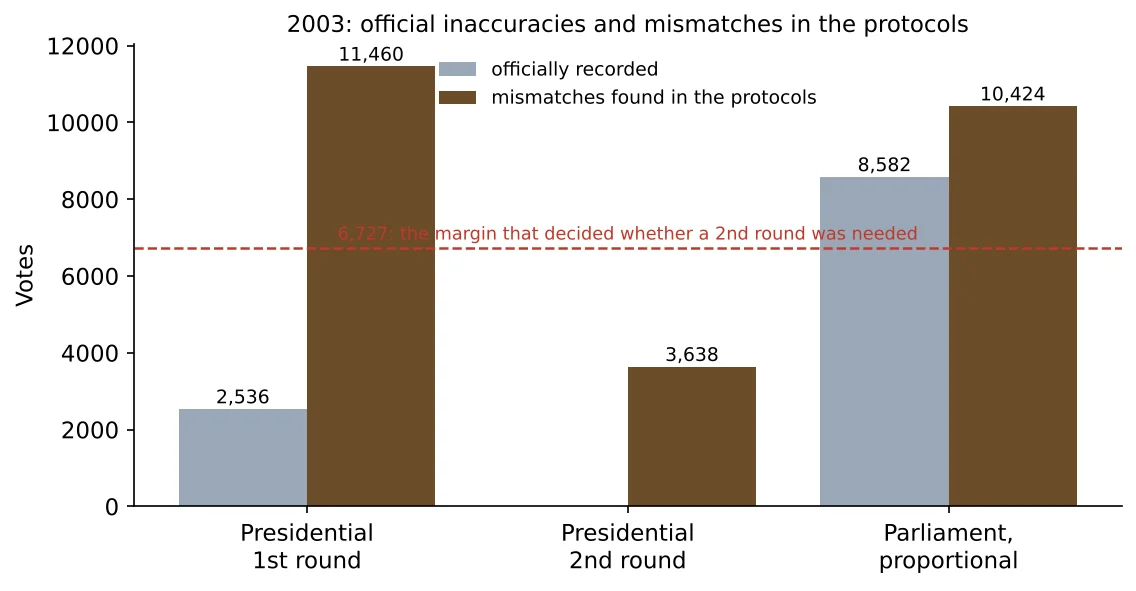
How to read this chart
Brown bars: mismatches found in the protocols; grey: official inaccuracies (no official total is given for the run-off).
What it shows
The run-off had fewer arithmetic mismatches than the first round, but a ten per cent jump in participants that the voter lists do not explain.
Villages where even the voters outnumber the residents are listed in villages with more voters than residents.
Source: “The Electoral Rights and Falsifications of Elections” (2010, in Armenian), the earlier Armenian book by the same author, which analyses the officially published figures of each election. The figures here are taken from it; page numbers refer to the PDF.
Data and sources on this site
From the book
This article is based on the 2010 Armenian edition of Electoral Rights and Election Falsification by Lyudvig Khachatryan, which explains the full method, the formulas and the cases behind it.