Armenia 2003 Presidential Election: 6,727 Votes From a First-Round Win, 11,460 Inaccuracies
The leader needed 6,727 more votes to win in the first round. The protocols contained 11,460 inaccuracies; the law required the results to be checked.
Original page on electionscount.info: The Electoral Rights and Falsifications of Elections (2010, PDF), p. 41Article 86 of the Electoral Code in force in 2003 declared a presidential election invalid at any round if the inaccuracies affecting the candidates’ votes significantly affected the result, so that the real result could not be restored and the winner determined, or if violations occurred that could have affected the result.
The arithmetic
- Votes cast for candidates (official): 1,416,357.
- Votes for the leading candidate: 701,462.
- A first-round win required more than half: 708,188.
- The shortfall: 708,188 − 701,462 = 6,727.
If the inaccuracies in the protocols exceeded 6,727, the result at the stations concerned had to be checked, and, if the real results could not be restored, the CEC had to declare the election invalid. The officially stated inaccuracy was 2,536; counted station by station, the author finds 11,460 at 435 stations.
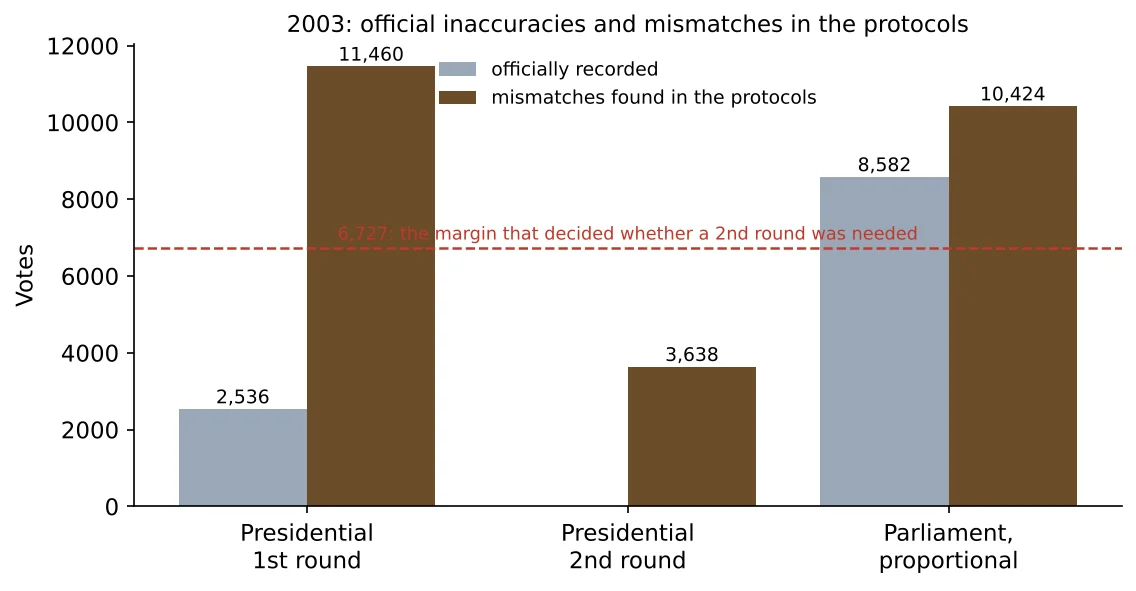
How to read this chart
The red line is the margin between the leader’s votes and an outright majority. Any inaccuracy larger than that could have changed whether a second round was needed.
What it shows
The official figure stayed below the line; the real mismatches were 1.7 times the margin. “No proper checks took place; there was a second round,” the book notes.
Here the inaccuracies were large enough to change the outcome of the round itself. The same reasoning is applied to seat allocation in 2007.
Other mismatches in the first round
- Ballots issued did not match cancelled plus used ballots at 306 stations, by more than 5,658.
- At 124 stations the ballots in the box exceeded the signatures of participants, by more than 4,782.
The general formula the book uses to find the smallest inaccuracy that changes a result is described in comparing election numbers.
Source: “The Electoral Rights and Falsifications of Elections” (2010, in Armenian), the earlier Armenian book by the same author, which analyses the officially published figures of each election. The figures here are taken from it; page numbers refer to the PDF.
Data and sources on this site
From the book
This article is based on the 2010 Armenian edition of Electoral Rights and Election Falsification by Lyudvig Khachatryan, which explains the full method, the formulas and the cases behind it.