Armenia 2003: Villages With More Voters Than Residents
Nerkin Hand in Syunik had 113 residents and 1,875 voters in the 2003 presidential election; three months later, 79.
Original page on electionscount.info: The Electoral Rights and Falsifications of Elections (2010, PDF), p. 43“It is clear that the number of participants in a community cannot exceed its population, children included.” The book compiles, from the census on armstat.am and the results on elections.am, a table of villages for the presidential election (both rounds) and the parliamentary election of 2003.
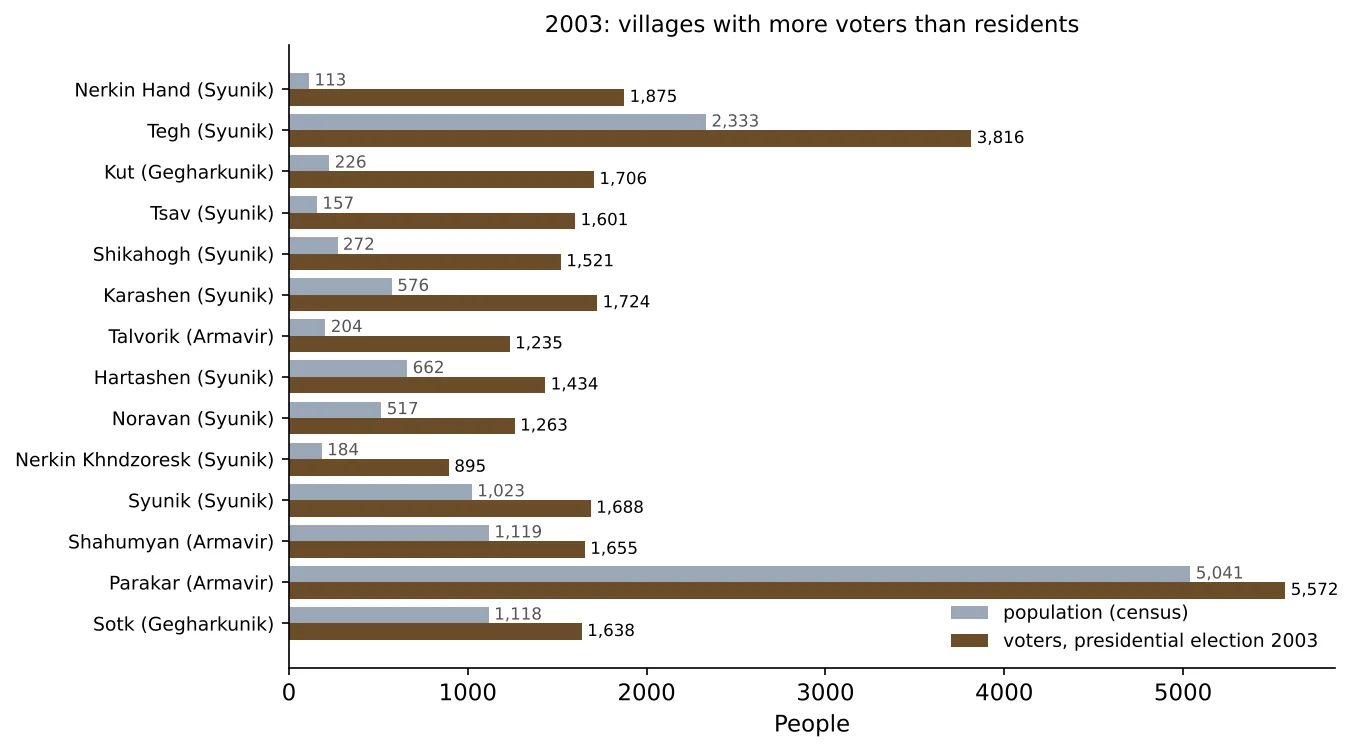
How to read this chart
Grey: the population of the village according to the census. Brown: voters on the list in the 2003 presidential election.
What it shows
- Nerkin Hand (Syunik): 113 residents, 1,875 voters, 1,751 participants in the first round and 1,860 in the second; in the parliamentary election three months later, 79 voters.
- Kut (Gegharkunik): 226 residents, 1,706 voters, 1,860 participants in the parliamentary vote.
- Tsav and Shikahogh (Syunik): about 150–270 residents and 1,500–1,600 voters each.
- Aravus (Syunik): 168 residents, 82 voters in the presidential election, 1,130 in the parliamentary.
Lists that grow and shrink by more than a thousand names in a small village between two elections point to voters brought in from elsewhere; the book links such cases to the rotation of military voters between stations.
The totals
- First presidential round: voters exceeded residents by about 20,000 in at least 48 villages; participants exceeded residents by about 12,000 in at least 21.
- Second round: about 20,000 in 48 villages; participants about 15,700 above the population in at least 27.
- Parliamentary election: voters about 21,300 above residents in at least 53 villages; participants about 13,600 above in at least 32.
Assuming 70–80% of residents are of voting age and 70–80% of them present and voting, i.e. 50–60% of the population, the book estimates the excess of participants over possible voters at about 25,400–62,200 in 100–340 villages in the first round, 31,100–97,500 in the second, and 35,100–67,600 in the parliamentary election: “an obvious addition of about 10–15% in participation, in small communities alone.”
Several of these villages, Kut, Karashen, Aravus, Nerkin Khndzoresk and Tegh, appear again in 2018, when their lists grew by hundreds of voters on election morning: see 2018 voter numbers.
Source: “The Electoral Rights and Falsifications of Elections” (2010, in Armenian), the earlier Armenian book by the same author, which analyses the officially published figures of each election. The figures here are taken from it; page numbers refer to the PDF.
Data and sources on this site
From the book
This article is based on the 2010 Armenian edition of Electoral Rights and Election Falsification by Lyudvig Khachatryan, which explains the full method, the formulas and the cases behind it.