Armenia 2012: Registered Voters Compared with the Population, by Province and Yerevan District
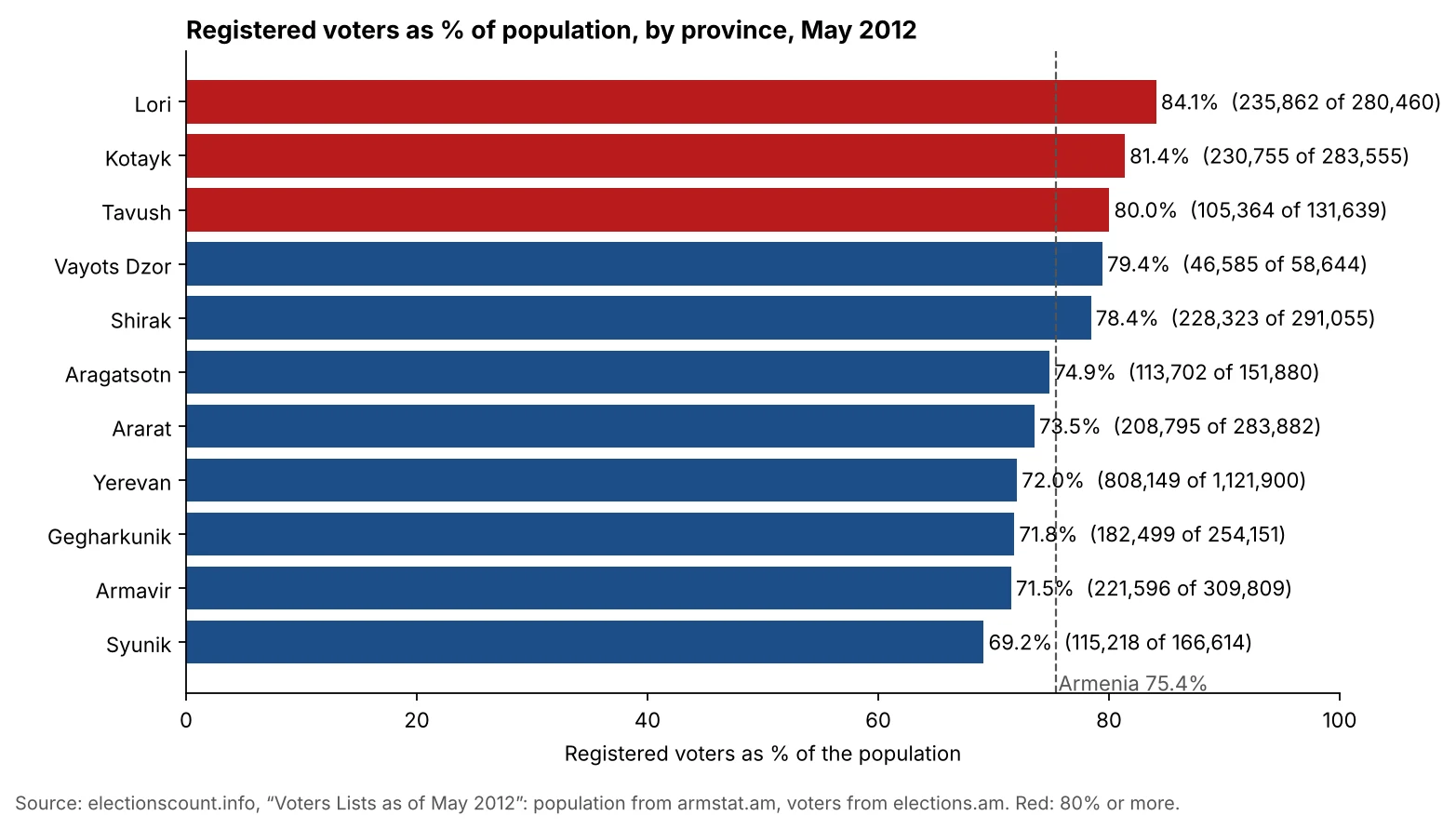
In May 2012 three of every four residents of Armenia were on the voter lists, and in Lori more than five of every six.
Original page on electionscount.info: Voters lists as of May 2012The monitoring site compared the voter lists published on elections.am in May 2012 with the population figures of the national statistics service, armstat.am. In total, 2,495,097 voters were registered for a population of 3,309,387, or 75.4%: 77.4% in towns (1,623,396 of 2,097,040) and 71.9% in villages (871,701 of 1,212,347).
How to read this chart
Each bar is one province or Yerevan: its registered voters divided by its population. The dashed line is the national figure, 75.4%. Red bars are 80% or more.
What it shows
Lori had 235,862 voters for 280,460 residents, 84.1%; Kotayk 81.4% and Tavush 80.0%. At the other end are Syunik (69.2%), Armavir (71.5%) and Gegharkunik (71.8%). Lori, Shirak and Tavush are also provinces that many people leave to work abroad, so their real resident population is likely to be lower, not higher, than the official figure.
How to read this chart
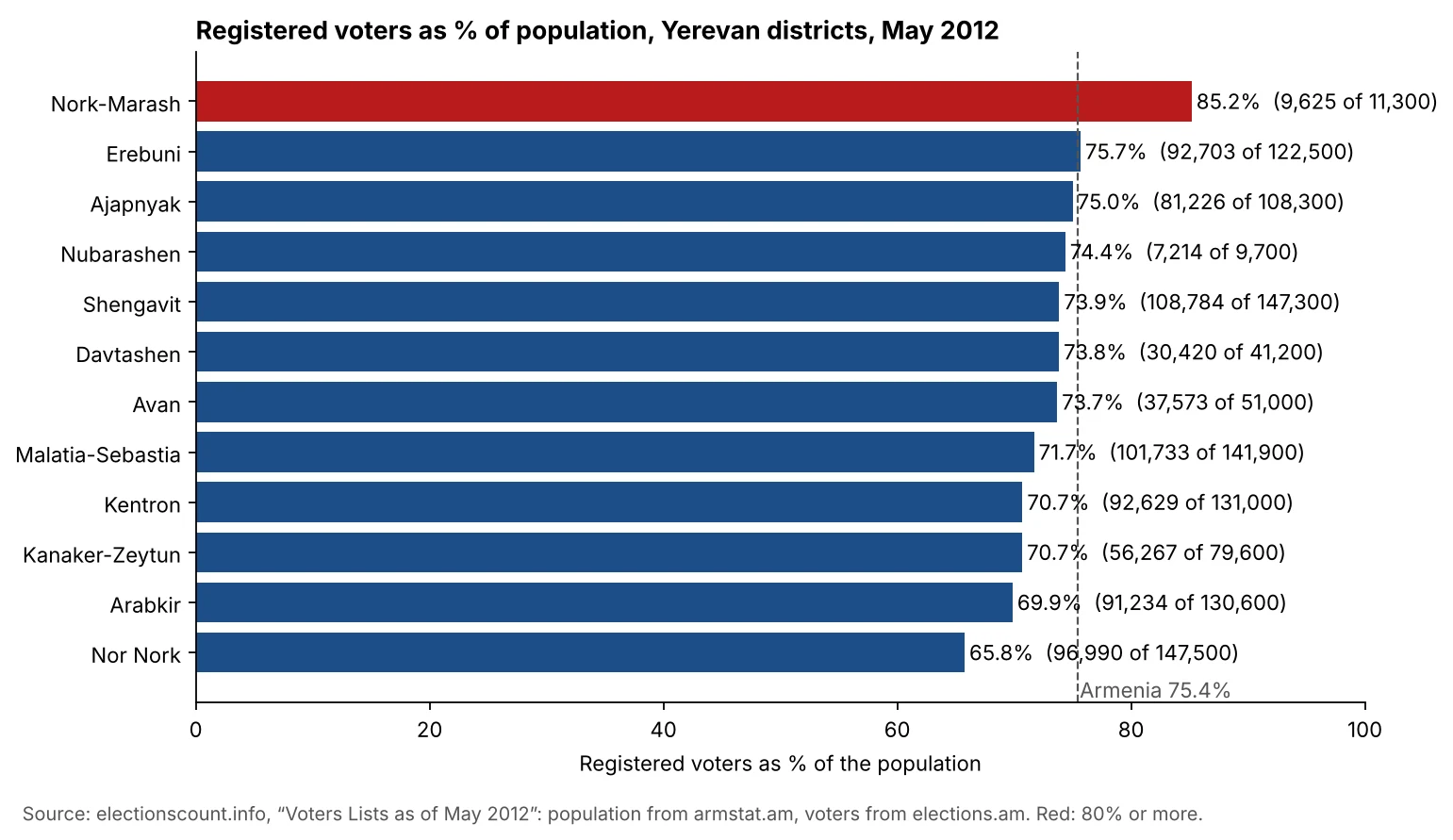
The same comparison for the 12 administrative districts of Yerevan, which together had 808,149 voters for 1,121,900 residents (72.0%).
What it shows
Nork-Marash stands out with 9,625 voters for 11,300 residents, 85.2%, followed by Erebuni (75.7%) and Ajapnyak (75.0%). Nor Nork has the lowest share, 65.8%.
Why 75% is already a lot
About a fifth of Armenia's population is under 18 and cannot vote. A voter list equal to three quarters of all residents therefore covers almost every adult, including everyone who lives abroad but is still registered at home. Lists above 80% leave hardly any room for children at all.
The gap became clearer after the 2011 census. The population figures in this table are the older estimates; the census put the population at about 3.02 million. Against that figure, the same 2,495,097 voters are 82.6% of the population, and the share kept rising to 87% by 2021 (see population and voters 1991–2021).
Inflated lists do not prove fraud by themselves, but they make it possible: every registered person who is not there is a signature that can be forged and a ballot that can be added without any mismatch in the numbers. That is the first of the six 2012 conclusions.
Data and sources on this site
From the book
This article is based on Chapters IV and VI of Electoral Rights and Election Falsification by Lyudvig Khachatryan, which explains the full method, the formulas and the cases behind it.