Armenia 2003 Parliamentary Elections: Results, Thresholds and 10,424 Inaccuracies
Six parties passed 5%; the seventh was about 4,700 votes short. The protocols contained 10,424 inaccuracies at 587 stations.
Original page on electionscount.info: The Electoral Rights and Falsifications of Elections (2010, PDF), p. 41In the parliamentary elections of May 2003, 1,197,075 people took part, according to the CEC. Twenty-one parties and alliances stood for the 75 party-list seats.
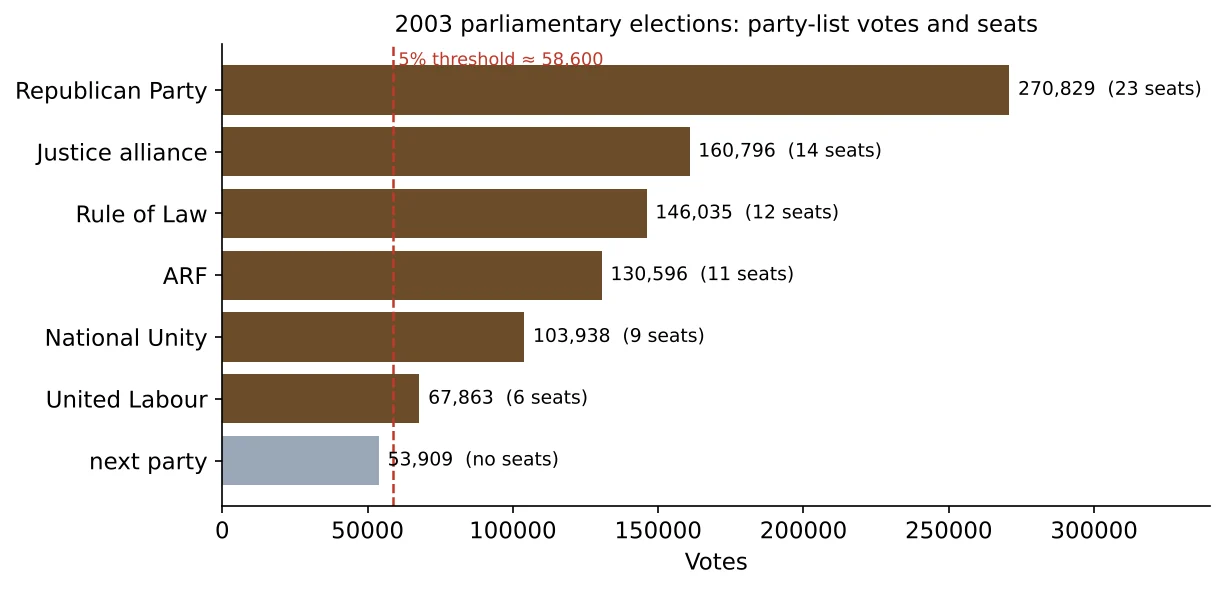
How to read this chart
Each bar is a list’s votes; the label gives its seats. The dashed line is the 5% threshold, calculated, as the law required, on all votes for lists plus the official inaccuracies (1,163,536 + 8,582).
What it shows
Six lists passed the threshold. The next one had 53,909 votes, about 4,700 short of the roughly 58,600 needed.
A gap of a few thousand votes decided whether a seventh party entered parliament, while the protocols contained more than twice as many inaccuracies.
Inaccuracies
- Officially stated inaccuracies: 8,582.
- Counted station by station: 10,424 at more than 587 stations (without the votes cast abroad).
- Mismatches between ballots issued and used: 346 stations, more than 5,806; ballots in the box above signatures: 346 stations, more than 3,305.
- Turnout of 100% or more at 10 stations, above 90% at 181, above 80% at 318.
If there had been no inaccuracies, or if their effect had been calculated exactly, the book concludes, the distribution of seats “could have been different”. Under Article 115 the proportional election was to be declared invalid if violations occurred that could have affected the results.
The same day, the district (majoritarian) and party-list votes were held at the same stations; their turnout did not match: see the turnout gap.
Source: “The Electoral Rights and Falsifications of Elections” (2010, in Armenian), the earlier Armenian book by the same author, which analyses the officially published figures of each election. The figures here are taken from it; page numbers refer to the PDF.
Data and sources on this site
From the book
This article is based on the 2010 Armenian edition of Electoral Rights and Election Falsification by Lyudvig Khachatryan, which explains the full method, the formulas and the cases behind it.