Armenia 2005: The Electoral Code Amendments and What They Left Open
The 2005 amendments added numbered ballot stubs and three-hourly turnout reports, but kept military voter lists secret and the commissions dependent on the President.
Original page on electionscount.info: The Electoral Rights and Falsifications of Elections (2010, PDF), p. 45The book reviews the amendments adopted in 2005, before the referendum of that year and the 2007 parliamentary elections, point by point.
- Seats: party lists 75 → 90, districts 56 → 41. “A small step forward, but…”
- Voter lists, with the addresses of each precinct, printed and on electronic media, are given to precinct chairs at least two days before the vote. Computers, however, were provided only for district and central commissions.
- The total number of registered voters is published the day before the vote (instead of three days before).
- The CEC publishes turnout every three hours until 21:00, with results summed up within 10 hours at the precinct, entered within 18 hours at the district commission and published as preliminary results within 28 hours. Publishing final turnout by 21:00 is possible, the author notes, only with direct electronic links to the precincts.
- Lists signed in military units and detention facilities are not published and cannot be copied. Perhaps justified for national security, but an obstacle to transparency: “by organising a rotation of soldiers between many polling stations, any candidate can be secured election.”
- Ballots must be perforated, with a numbered stub torn off when the ballot is issued; the stubs are counted and sealed. A step forward, but the stubs and the signed lists stay at the precinct during the count, and false signatures can be added before the end of voting anyway.
- CEC: one member from each parliamentary party and one appointed by the President, who also confirms the composition and fills it from Court of Cassation judges if needed. District and precinct commissions are formed member by member. “Not all competing sides are given equal representation.”
- Ministers, governors and mayors may now stand for parliament without resigning; the requirement of voters’ signatures to nominate candidates was removed.
- Proxies may not be removed from the polling room except on arrest, a reform the author weighs against the arrests of proxies in 2003.
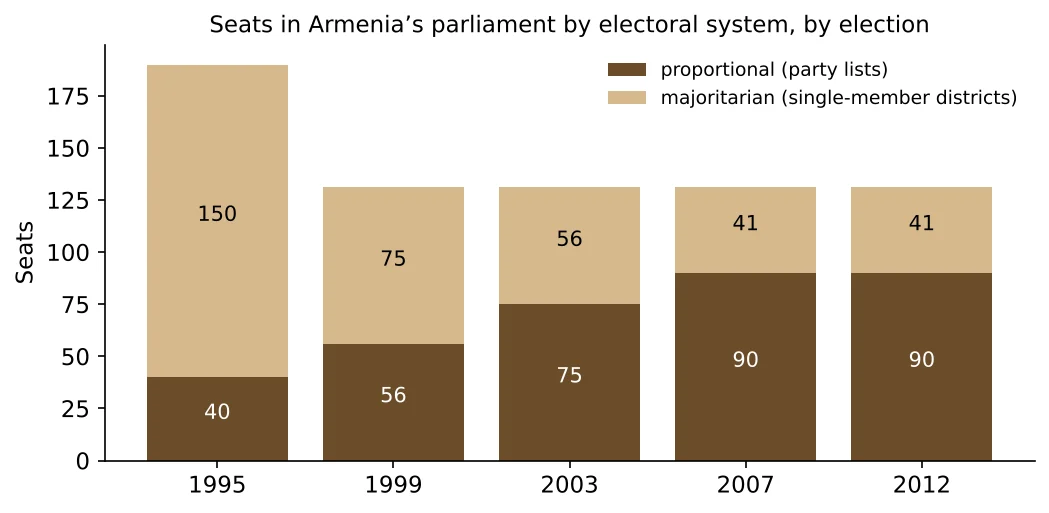
How to read this chart
Each bar is one parliamentary election. The dark part is the seats distributed between party lists in proportion to their votes; the light part is the seats won in single-member districts by whoever came first.
What it shows
From 2007 to 2012, 90 seats were elected by party list and 41 in districts.
The elections held under these rules: 2005 local elections, 2005 referendum, and the further changes before 2007.
Source: “The Electoral Rights and Falsifications of Elections” (2010, in Armenian), the earlier Armenian book by the same author, which analyses the officially published figures of each election. The figures here are taken from it; page numbers refer to the PDF.
Data and sources on this site
From the book
This article is based on the 2010 Armenian edition of Electoral Rights and Election Falsification by Lyudvig Khachatryan, which explains the full method, the formulas and the cases behind it.