Armenia 2007: Weak Points in the Electoral Code Before the Parliamentary Elections
One precinct seal for two places at once, protocols that can be “corrected” after the count, and no rule for when inaccuracies change the seat allocation.
Original page on electionscount.info: The Electoral Rights and Falsifications of Elections (2010, PDF), p. 52The Code was amended again before the elections of 12 May 2007. The book finds serious gaps, ambiguities and internal contradictions in it, and proposes remedies.
Problems and proposals
- Publish the numbers in three groups as they become known. Voters, ballots and envelopes are known before voting starts; participants, unused and cancelled ballots and stubs before the box is opened; the contents of the box after it is opened. Recording each group in a separate protocol, sent up and published at once, would prevent numbers being changed later. In 2007 the numbers in several protocols were changed.
- Decisions by one member. During the election period, sessions are valid regardless of how many members attend, and a decision passes if more members vote for than against: in theory a decision can be taken by a single member.
- Corrections at the district commission. Article 63 lets the precinct chair and secretary correct “arithmetic errors” in their protocol at the district commission after the count. The Code does not define the “source data” that may not be changed, so the inaccuracy itself can be altered, though a single inaccuracy may decide a party’s seats.
- Mobile ballot boxes. Each precinct receives one seal for envelopes, yet voting with a mobile box takes place elsewhere at the same time; and mobile-box votes are counted together with the station’s, without a separate protocol.
- Inaccuracies and seats. The threshold is calculated on valid votes plus inaccuracies, which penalises parties near the threshold and helps those above it, and nothing in the Code measures whether the inaccuracies change the allocation. See the 2007 example.
- Invalidating a station turns its participants into inaccuracies. A single district commission can therefore make the whole proportional election open to annulment, or seats can be distributed with any inaccuracy, “depending on expediency”.
- Presidential elections: annulment depends on inaccuracies exceeding the gap between the top two, ignoring the gap between second and third, which decides who enters the run-off.
- Council elections: the formula for annulment in Article 134 is, as written, not mathematically meaningful.
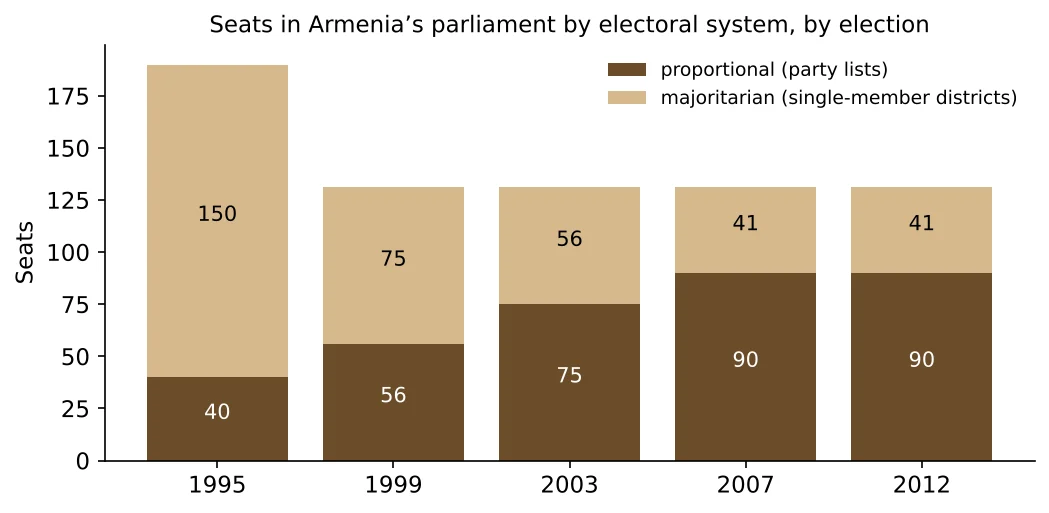
How to read this chart
Each bar is one parliamentary election. The dark part is the seats distributed between party lists in proportion to their votes; the light part is the seats won in single-member districts by whoever came first.
What it shows
The 2007 parliament was elected with 90 party-list and 41 district seats.
Source: “The Electoral Rights and Falsifications of Elections” (2010, in Armenian), the earlier Armenian book by the same author, which analyses the officially published figures of each election. The figures here are taken from it; page numbers refer to the PDF.
Data and sources on this site
From the book
This article is based on the 2010 Armenian edition of Electoral Rights and Election Falsification by Lyudvig Khachatryan, which explains the full method, the formulas and the cases behind it.