Armenia 2009: The First Yerevan Council Election and What Followed
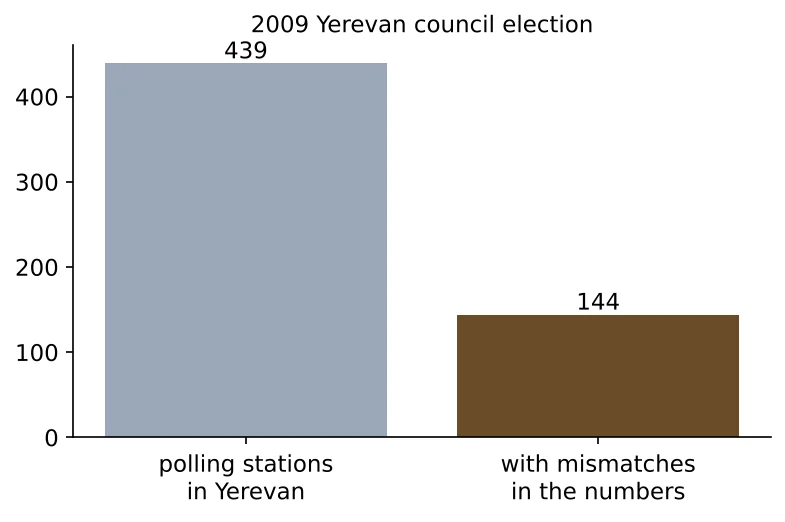
Of Yerevan’s 439 polling stations, 144 had mismatches between their numbers; on election day minibuses brought people to almost every station.
Original page on electionscount.info: The Electoral Rights and Falsifications of Elections (2010, PDF), p. 63In 2009 Yerevan elected its council for the first time; the council then elected the mayor. A direct election of the mayor “could not happen”, the book argues, for a simple political reason: a mayor elected directly by the capital would rival the president in authority, creating a risk of dual power.
The council was elected by party lists in a single citywide constituency with a 7% threshold.
How to read this chart
Grey: all polling stations formed in Yerevan; brown: those whose protocol numbers did not agree.
What it shows
144 of the 439 stations, a third, had mismatches between electoral numbers. On election day people were brought by minibus to almost every station.
New elections or a new disaster
The book’s closing chapter on Armenia, written after the presidential election of 2008, which ended in loss of life, argues that the coalition formed after it could not claim the support of a majority of voters, and that the way out lay in new elections held fairly rather than in force. In the chapters that follow it proposes a parliament elected in multi-member districts using the preferential principle, so that deputies depend on the voters rather than on party leaders, together with rules that make every electoral number checkable.
The method the book develops for that purpose, exact calculations of the inaccuracies that change a result, was later applied to every election on this site, starting with 2012. The method in short: comparing election numbers.
Source: “The Electoral Rights and Falsifications of Elections” (2010, in Armenian), the earlier Armenian book by the same author, which analyses the officially published figures of each election. The figures here are taken from it; page numbers refer to the PDF.
Data and sources on this site
From the book
This article is based on the 2010 Armenian edition of Electoral Rights and Election Falsification by Lyudvig Khachatryan, which explains the full method, the formulas and the cases behind it.