Armenia 2013: Voter Lists vs Population, 2001–2013
Between the 2001 and 2011 censuses Armenia lost 194,157 permanent residents, yet its voter list grew by 202,346; in Lori it has more voters than residents.
Original page on electionscount.info: Number of voters and population from 2001 to 2013Armenia elected its president on 18 February 2013. Seven candidates stood; the incumbent Serzh Sargsyan (Republican Party) was declared the winner in the first round, and Raffi Hovannisian (Heritage) came second. The monitoring site for this election is at elections.transparency.am/2013.
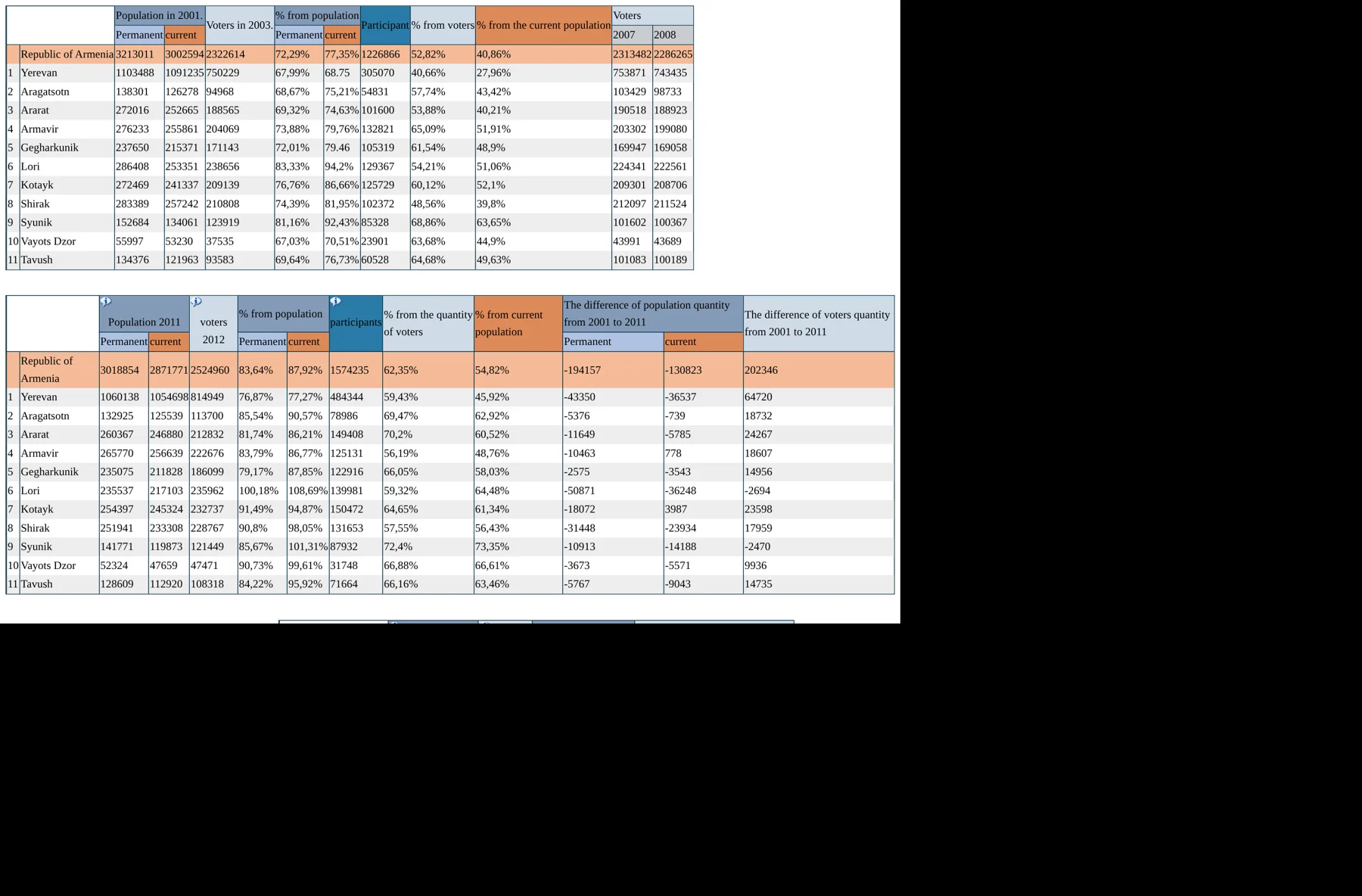
The page “Number of voters and population from 2001 to 2013” compares the voter lists with the census, province by province, for three moments: the 2001 census with the 2003 voter list, the 2011 census with the 2012 list, and the 2011 census with the 2013 list.
How to read this chart
- Population, permanent and current: from the census. “Permanent” counts people registered as residents; “current” counts those actually living there.
- Voters: people on the voter list in that year.
- % from population: voters as a share of permanent and of current population.
- Participants, % from voters, % from the current population: people who voted.
- The difference of population / voters from 2001 to 2011: how both changed over ten years.
- The i icons give the sources: the census results on armstat.am, the voter lists on elections.am and police.am.
What it shows
In 2003 voters were 77.35% of the current population. By 2012 they were 87.92%. Between the censuses the permanent population fell by 194,157 and the current population by 130,823, but the number of voters rose by 202,346.
How to read this chart
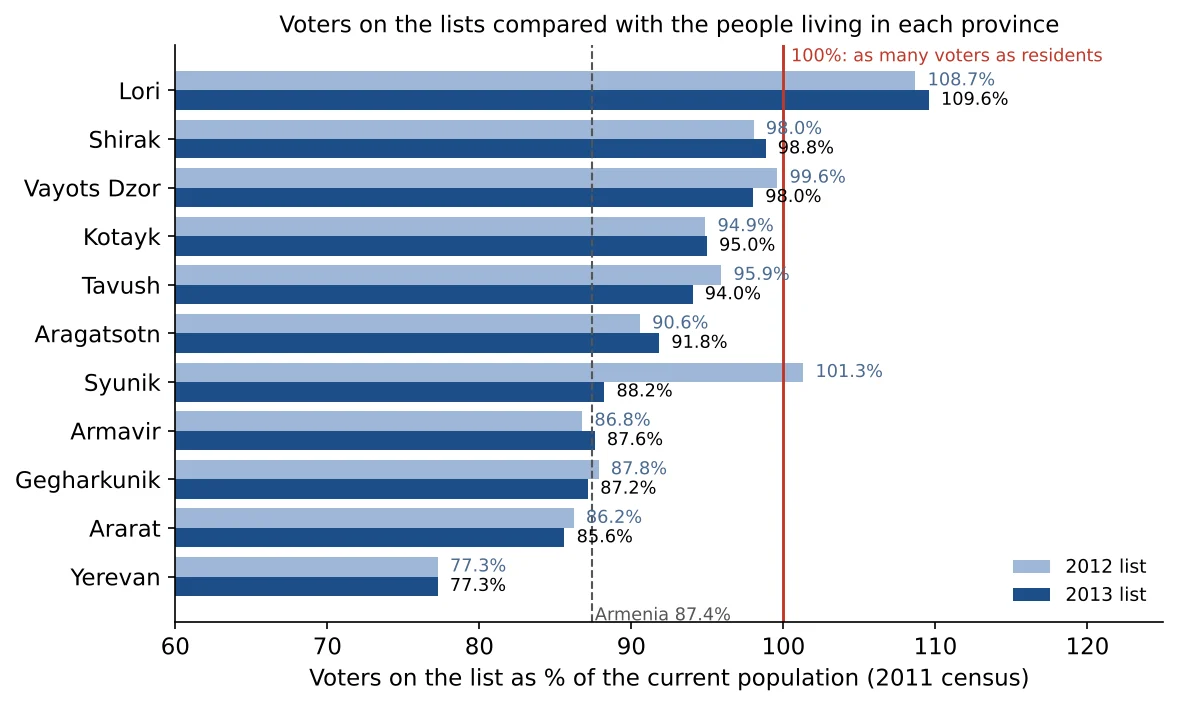
Each pair of bars is one province: the light bar is the 2012 list, the dark bar the 2013 list, both divided by the current population of the 2011 census. The red line is 100%: as many voters as residents of all ages.
What it shows
- Lori: 237,869 voters in 2013 for 217,103 residents, 109.6%.
- Syunik: 101.3% in 2012; 88.2% in 2013 after its list shrank.
- Shirak, Vayots Dzor, Kotayk and Tavush: 94–99%.
- Yerevan: 77.3%, the only province close to what age structure allows.
A province cannot have more adults than residents. Lists that are larger than the population that lives there contain tens of thousands of people who have left, and the provinces where this is worst are the places to look for votes cast in absent people’s names.
How large should the list be?
In 2011 about a fifth of Armenia’s residents were under 18. Even if every adult resident were on the list, voters could not reach much more than about 80% of the current population. The national list in 2013, 2,510,887 names on the basic list published on police.am, is 87.43% of the current population; the figure used on election day, 2,528,773, is 88.06%. The surplus over what the age structure allows is of the order of 200,000 names.
In 2013 citizens living abroad could not vote from abroad (apart from diplomatic staff and their families), so a name on the list of someone who lives abroad is not a vote that can be cast honestly; it can only be cast by someone else. This is why the site and the book check the lists before the results; see voting on behalf of others and the same comparison for 2012 in voter lists vs population, 2012.
The third table on the page gives the 2013 list by province with the change from 2012: +27,463 voters nationally in one year, while the population kept falling.
Data and sources on this site
From the book
This article is based on Chapter VI of Electoral Rights and Election Falsification by Lyudvig Khachatryan, which explains the full method, the formulas and the cases behind it.