Armenia 2013 Presidential Election: Population, Voters and Votes by Turnout
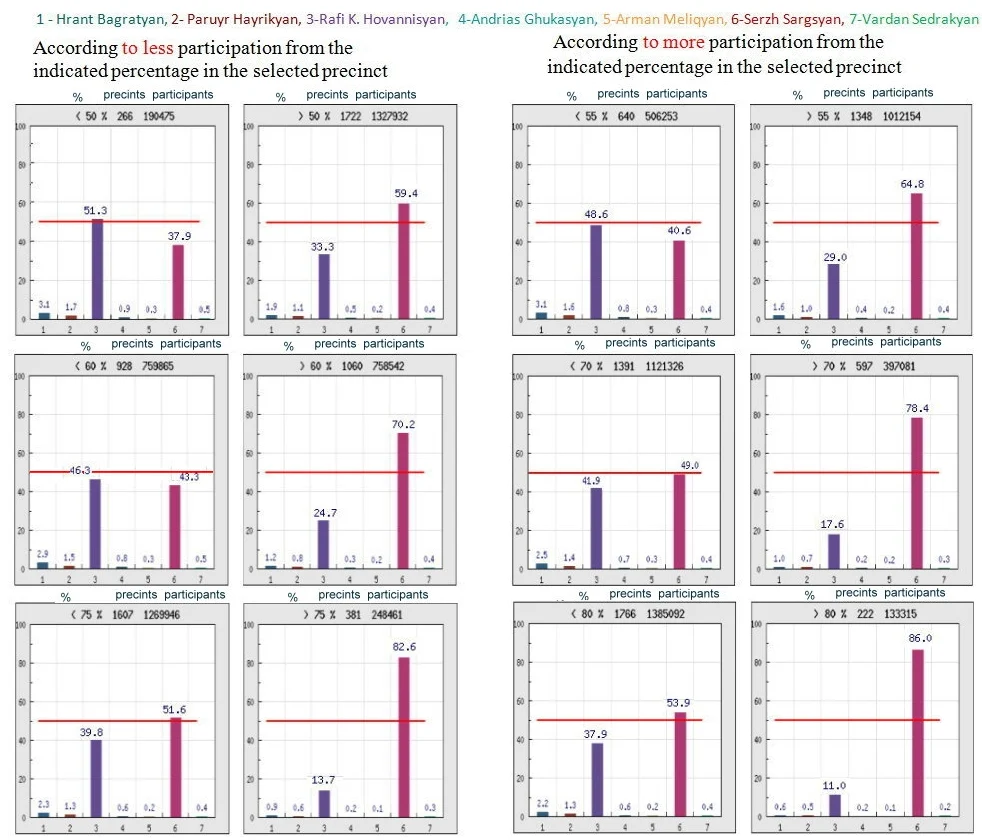
In the 928 precincts with turnout under 60%, Serzh Sargsyan had 43.3% of the vote, short of a first-round win; above 80% turnout he had 86%.
Original page on electionscount.info: Presidential elections of Armenia 2013: home pageArmenia elected its president on 18 February 2013. Seven candidates stood; the incumbent Serzh Sargsyan (Republican Party) was declared the winner in the first round, and Raffi Hovannisian (Heritage) came second. The monitoring site for this election is at elections.transparency.am/2013.
The home page of the 2013 section shows two pictures that sum up the election: how many people live in Armenia compared with how many were on the voter list, and how the two leading candidates’ votes change with turnout.
How to read this chart
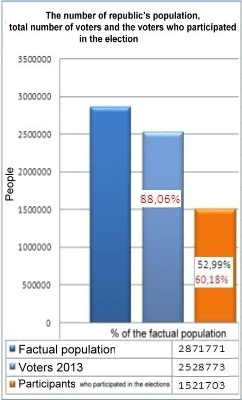
- Dark blue: the factual (current) population counted by the 2011 census, 2,871,771.
- Light blue: registered voters in 2013, 2,528,773.
- Orange: people who took part in the vote, 1,521,703.
- The red figures are percentages: voters as % of the population, participants as % of the population and as % of voters.
What it shows
Voters equal 88.06% of everyone living in the country, children included. Participants equal 52.99% of the population and 60.18% of the voters.
In a country where about a fifth of the population is under 18, a voter list as large as 88% of all residents must contain many people who no longer live there. Every name on the list who is abroad is a name in whose place someone else can vote.
How to read this chart
The charts come in pairs. In each pair the left panel covers the precincts with turnout below the limit and the right panel those above it. The heading gives the limit, the number of precincts and the number of participants. The seven bars are the candidates, numbered as in the key below; heights are % of participants. The red line is 50%, the share needed to win in the first round.
Candidates on the site’s charts: 1 Hrant Bagratyan, 2 Paruyr Hayrikyan, 3 Raffi Hovannisian, 4 Andrias Ghukasyan, 5 Arman Melikyan, 6 Serzh Sargsyan, 7 Vardan Sedrakyan.
What it shows
| Limit | Below: precincts | Sargsyan | Hovannisian | Above: precincts | Sargsyan | Hovannisian |
|---|---|---|---|---|---|---|
| 50% | 266 | 37.9 | 51.3 | 1,722 | 59.4 | 33.3 |
| 55% | 640 | 40.6 | 48.6 | 1,348 | 64.8 | 29.0 |
| 60% | 928 | 43.3 | 46.3 | 1,060 | 70.2 | 24.7 |
| 70% | 1,391 | 49.0 | 41.9 | 597 | 78.4 | 17.6 |
| 75% | 1,607 | 51.6 | 39.8 | 381 | 82.6 | 13.7 |
| 80% | 1,766 | 53.9 | 37.9 | 222 | 86.0 | 11.0 |
In the 928 precincts with turnout under 60%, which had half of all participants (759,865 of about 1.52 million), Hovannisian was ahead and Sargsyan had 43.3%, below the 50% needed to win outright. Sargsyan’s first-round majority came from the high-turnout precincts.
Below 60% the two leading candidates are close and neither passes 50%. Above 80% Sargsyan reaches 86% and Hovannisian falls to 11%, while the minor candidates shrink too. If high turnout came from real voters, it would raise every candidate’s vote. Here the extra turnout goes almost entirely to one candidate, the pattern discussed in comparing election numbers. You can choose any limit yourself on the interactive version of this chart, explained in votes by turnout, 2013.
The other 2013 articles cover the voter lists and population, the communities sorted by turnout, the community table, Yerevan, the commission chairs, the observers, the protocol mismatches and the voting procedure.
Data and sources on this site
From the book
This article is based on Chapter VI of Electoral Rights and Election Falsification by Lyudvig Khachatryan, which explains the full method, the formulas and the cases behind it.