Armenia 2026: Party Votes at High- and Low-Turnout Polling Stations
Civil Contract did best at both ends: at stations with the lowest and the highest turnout. Strong Armenia did best in the middle.
Original page on electionscount.info: Distribution of votes by turnout percentage, 2026The 2026 monitoring page lets you type any turnout figure and splits all 2,006 polling stations into two groups: above it and at or below it. For each group it shows every party's share. The share is counted from the votes for parties plus the stations' discrepancies, so it is close to, but not the same as, the official percentage.
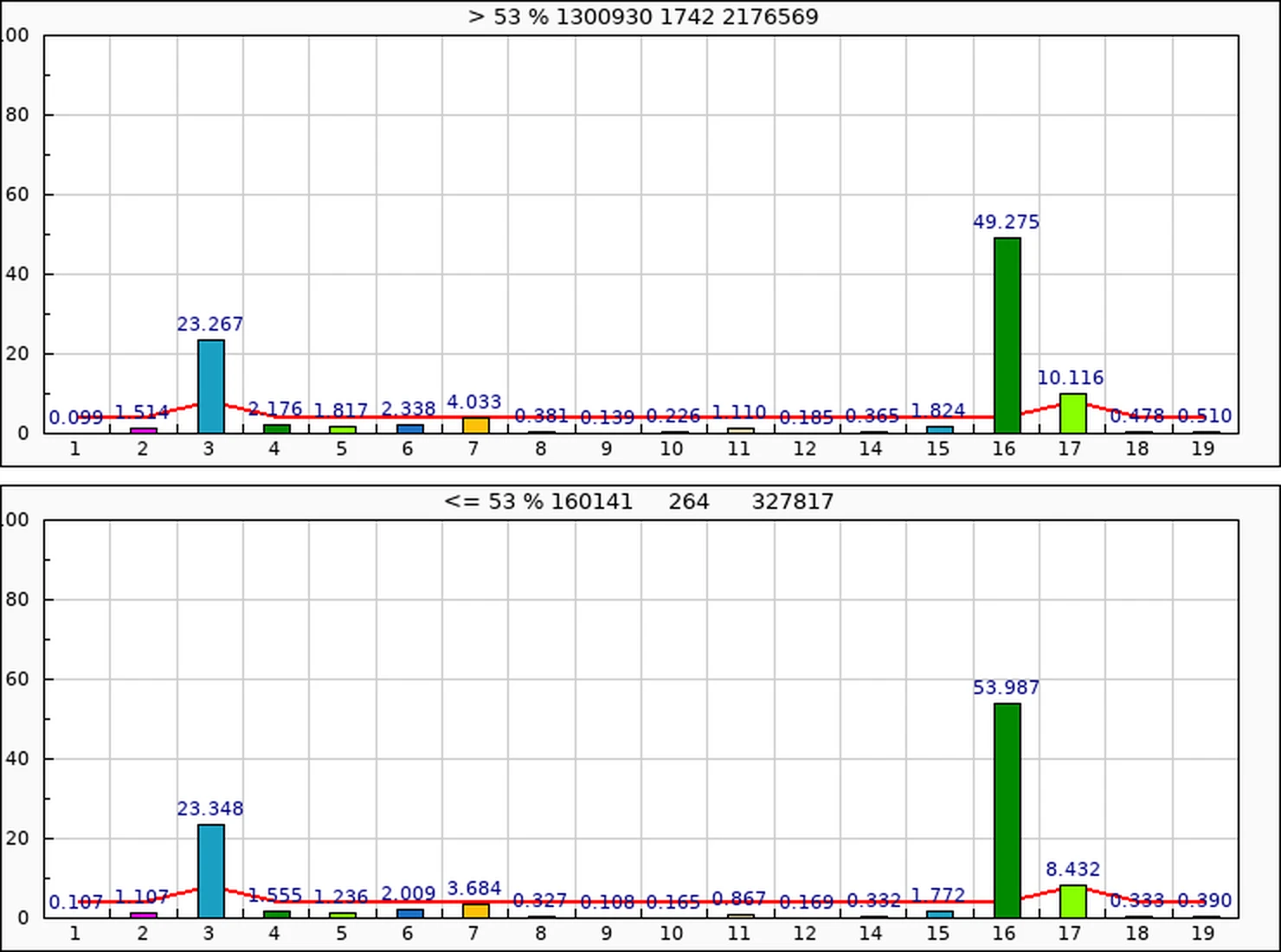
How to read this chart
Bars are the 18 parties, numbered as on the ballot. Top chart: polling stations with turnout above 53% (1,742 stations, 2,176,569 voters, 1,300,930 participants). Bottom chart: stations at or below 53% (264 stations, 327,817 voters, 160,141 participants). The red line is the threshold: 4% for a party, 8% for an alliance.
What it shows
53% is the page's default. The 264 lower-turnout stations gave Civil Contract (16) 53.99%, the 1,742 others 49.28%. Strong Armenia (3) is almost the same in both groups, 23.35% and 23.27%; the Armenia alliance (17) is weaker at low turnout, 8.43% against 10.12%.
Party numbers: 1 Reformists Party; 2 «I Am Against All» Democratic Party; 3 Strong Armenia alliance; 4 Meritocratic Party; 5 «New Force»; 6 «Wings of Unity»; 7 Prosperous Armenia; 8 National Democratic Pole; 9 Kochari Party; 10 Armenian National Congress; 11 Republic Party; 12 Christian-Democratic Party; 14 Democratic Consolidation; 15 Democracy, Law, Discipline; 16 Civil Contract; 17 «Armenia» alliance; 18 «For the Republic» alliance; 19 Bright Armenia.
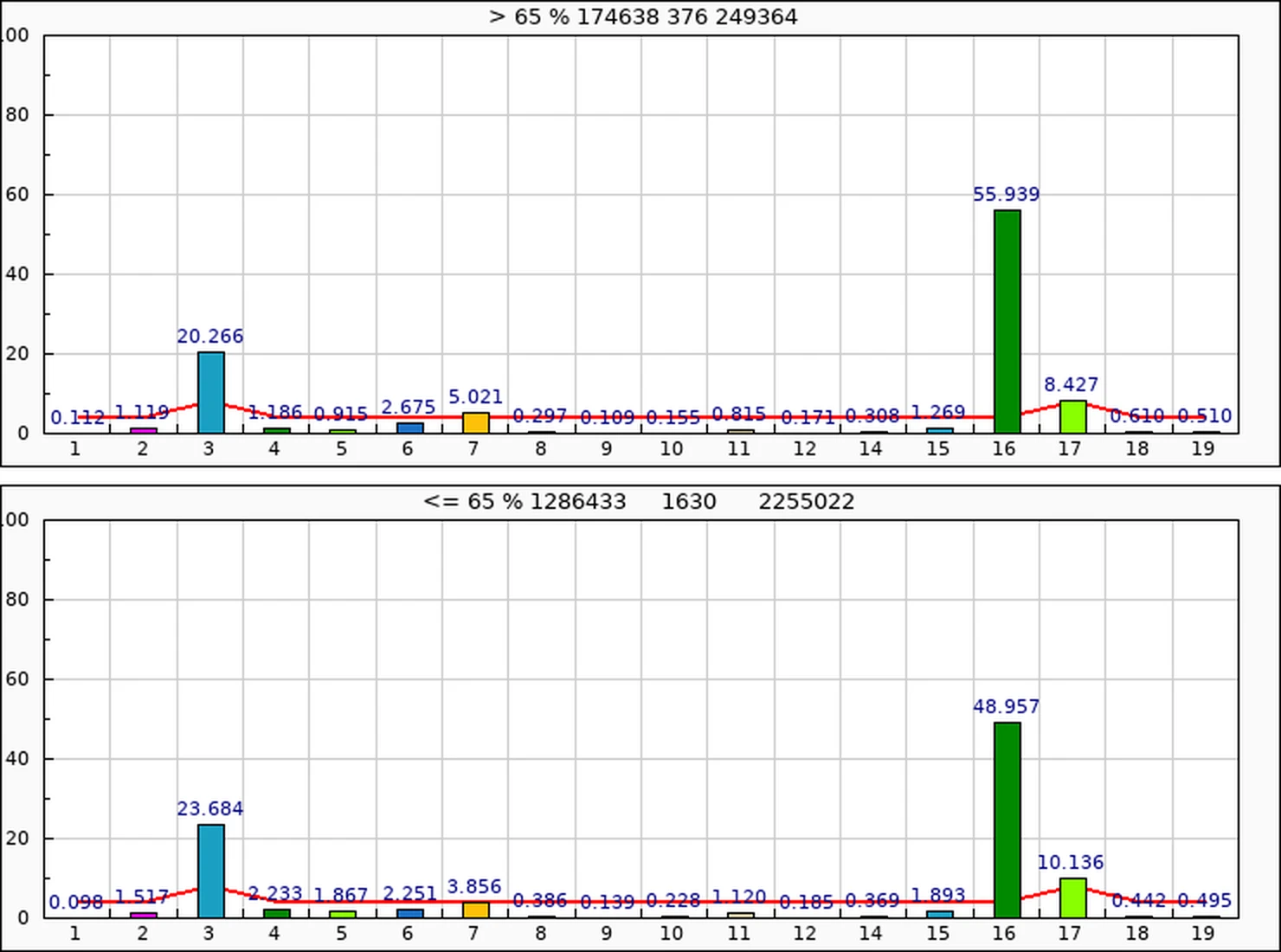
How to read this chart
Bars are the 18 parties, numbered as on the ballot. Top chart: polling stations with turnout above 65% (376 stations, 249,364 voters, 174,638 participants). Bottom chart: stations at or below 65% (1,630 stations, 2,255,022 voters, 1,286,433 participants). The red line is the threshold: 4% for a party, 8% for an alliance.
What it shows
At the 376 stations with turnout above 65%, Civil Contract rises to 55.94%, against 48.96% at all the others. Strong Armenia falls to 20.27%, Prosperous Armenia (7) rises to 5.02%.
Party numbers: 1 Reformists Party; 2 «I Am Against All» Democratic Party; 3 Strong Armenia alliance; 4 Meritocratic Party; 5 «New Force»; 6 «Wings of Unity»; 7 Prosperous Armenia; 8 National Democratic Pole; 9 Kochari Party; 10 Armenian National Congress; 11 Republic Party; 12 Christian-Democratic Party; 14 Democratic Consolidation; 15 Democracy, Law, Discipline; 16 Civil Contract; 17 «Armenia» alliance; 18 «For the Republic» alliance; 19 Bright Armenia.
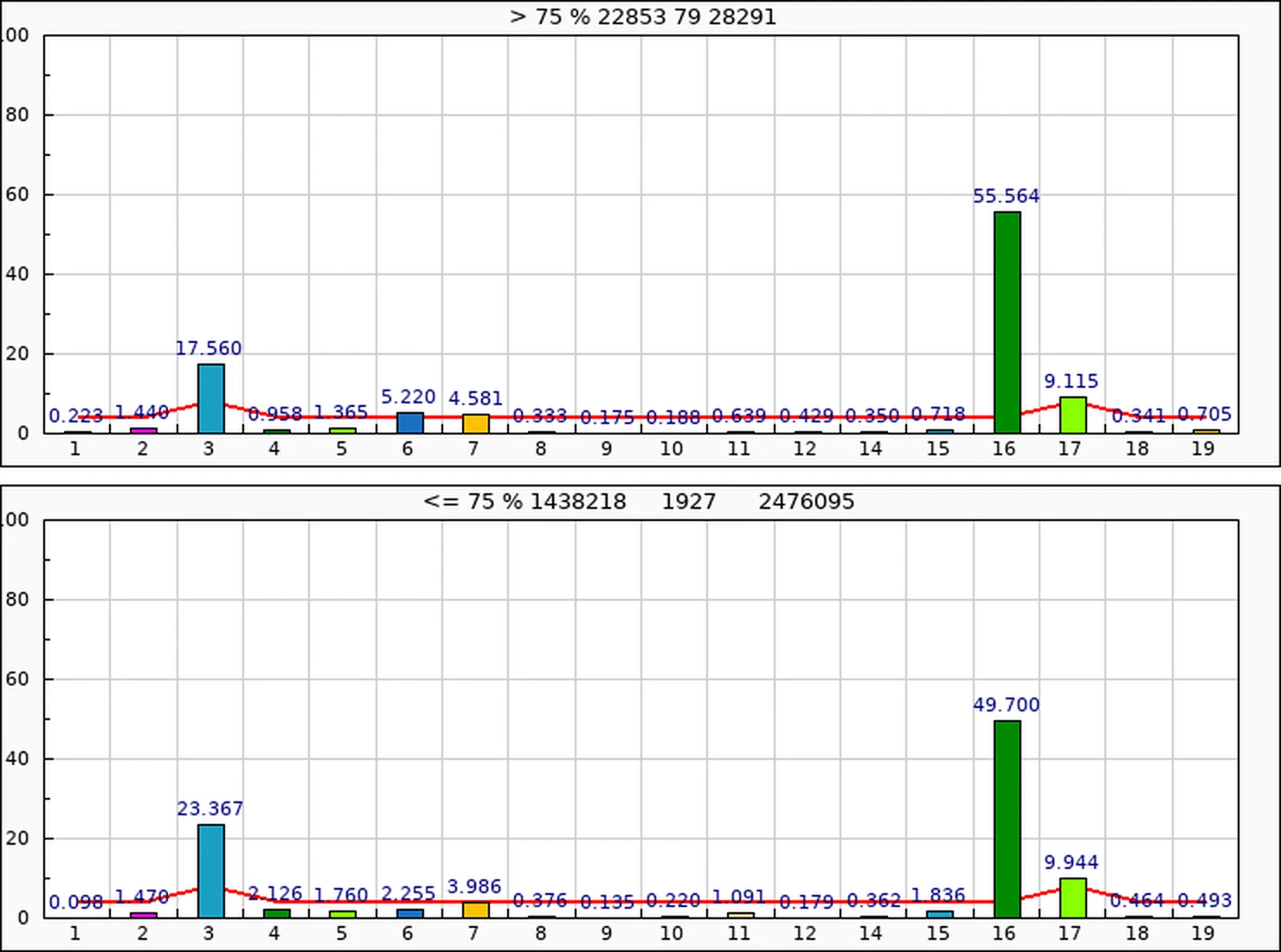
How to read this chart
Bars are the 18 parties, numbered as on the ballot. Top chart: polling stations with turnout above 75% (79 stations, 28,291 voters, 22,853 participants). Bottom chart: stations at or below 75% (1,927 stations, 2,476,095 voters, 1,438,218 participants). The red line is the threshold: 4% for a party, 8% for an alliance.
What it shows
At the 79 stations with turnout above 75%, Civil Contract has 55.56%, Strong Armenia 17.56%, and «Wings of Unity» (6) 5.22%, more than twice its usual share. These stations are small: 28,291 voters in total, about 1% of the country.
Party numbers: 1 Reformists Party; 2 «I Am Against All» Democratic Party; 3 Strong Armenia alliance; 4 Meritocratic Party; 5 «New Force»; 6 «Wings of Unity»; 7 Prosperous Armenia; 8 National Democratic Pole; 9 Kochari Party; 10 Armenian National Congress; 11 Republic Party; 12 Christian-Democratic Party; 14 Democratic Consolidation; 15 Democracy, Law, Discipline; 16 Civil Contract; 17 «Armenia» alliance; 18 «For the Republic» alliance; 19 Bright Armenia.
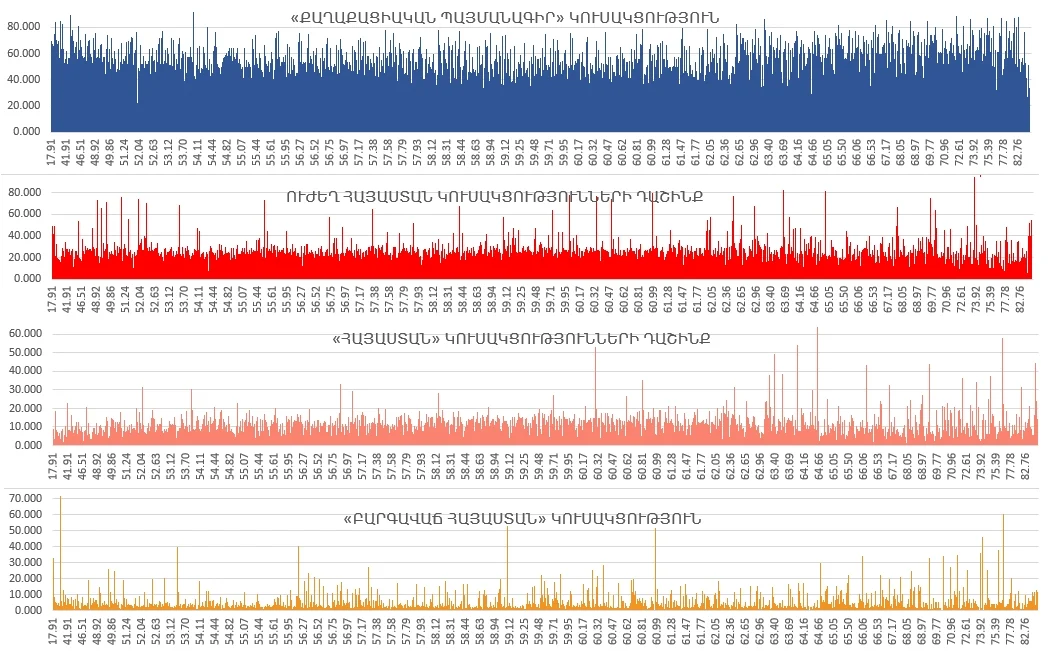
How to read this chart
Each panel is one party; every thin bar is one polling station, sorted by turnout from 17.91% on the left to over 82% on the right. The height is the party's share of the vote at that station.
What it shows
Civil Contract (top) stays mostly between 50% and 80% across the whole range. Strong Armenia stays around 20–30% with scattered spikes. The Armenia alliance and Prosperous Armenia are low almost everywhere but have single stations with 40–70%, mostly on the right, high-turnout side.
Key to the Armenian labels: «ՔԱՂԱՔԱՑԻԱԿԱՆ ՊԱՅՄԱՆԱԳԻՐ» = Civil Contract; ՈՒԺԵՂ ՀԱՅԱՍՏԱՆ … ԴԱՇԻՆՔ = Strong Armenia alliance; «ՀԱՅԱՍՏԱՆ» … ԴԱՇԻՆՔ = Armenia alliance; «ԲԱՐԳԱՎԱԾ ՀԱՅԱՍՏԱՆ» = Prosperous Armenia.
What to make of it
In 2015 the winner's share rose steadily with turnout. In 2026 there is no steady rise: Civil Contract is a few points stronger at both the lowest- and the highest-turnout stations, and weakest in between. The pattern at the high end is concentrated in a small number of small stations, which is where the capacity check and the comparison of signatures, envelopes and ballots should be applied first. The 2026 turnout and speed table on the site does that station by station.
Data and sources on this site
From the book
This article is based on Chapter VI of Electoral Rights and Election Falsification by Lyudvig Khachatryan, which explains the full method, the formulas and the cases behind it.