Armenia 2018: 150 Polling Stations at or Faster Than 60 Seconds per Voter
In 2018 only 150 stations reached 60 seconds per voter, against 668 in 2017; at the 44-second limit, 7 remain.
Original page on electionscount.info: Turnout during voting and calculation of voting speed, 2018Armenia held early parliamentary elections on 9 December 2018, half a year after the change of power. Eleven lists stood. Nikol Pashinyan’s My Step alliance won about 70% of the vote; Prosperous Armenia and Bright Armenia also passed the threshold (5% for parties, 7% for alliances). Turnout was 48.6%.
The page “Turnout during voting and calculation of voting speed” applies to 2018 the same test as the 2017 page: from the turnout reports at 11:00, 14:00, 17:00 and 20:00 it works out the time each polling station had per voter in each 3-hour window, and lists the stations where that time was at or below a limit you choose. The default limit is 60 seconds, explained on the page: video measurements showed that registration and handing out the ballots took at least 70 seconds and a whole vote more than 90; the page counts only the single longest operation and allows two voters per 60 seconds at stations with more than 1,000 voters.
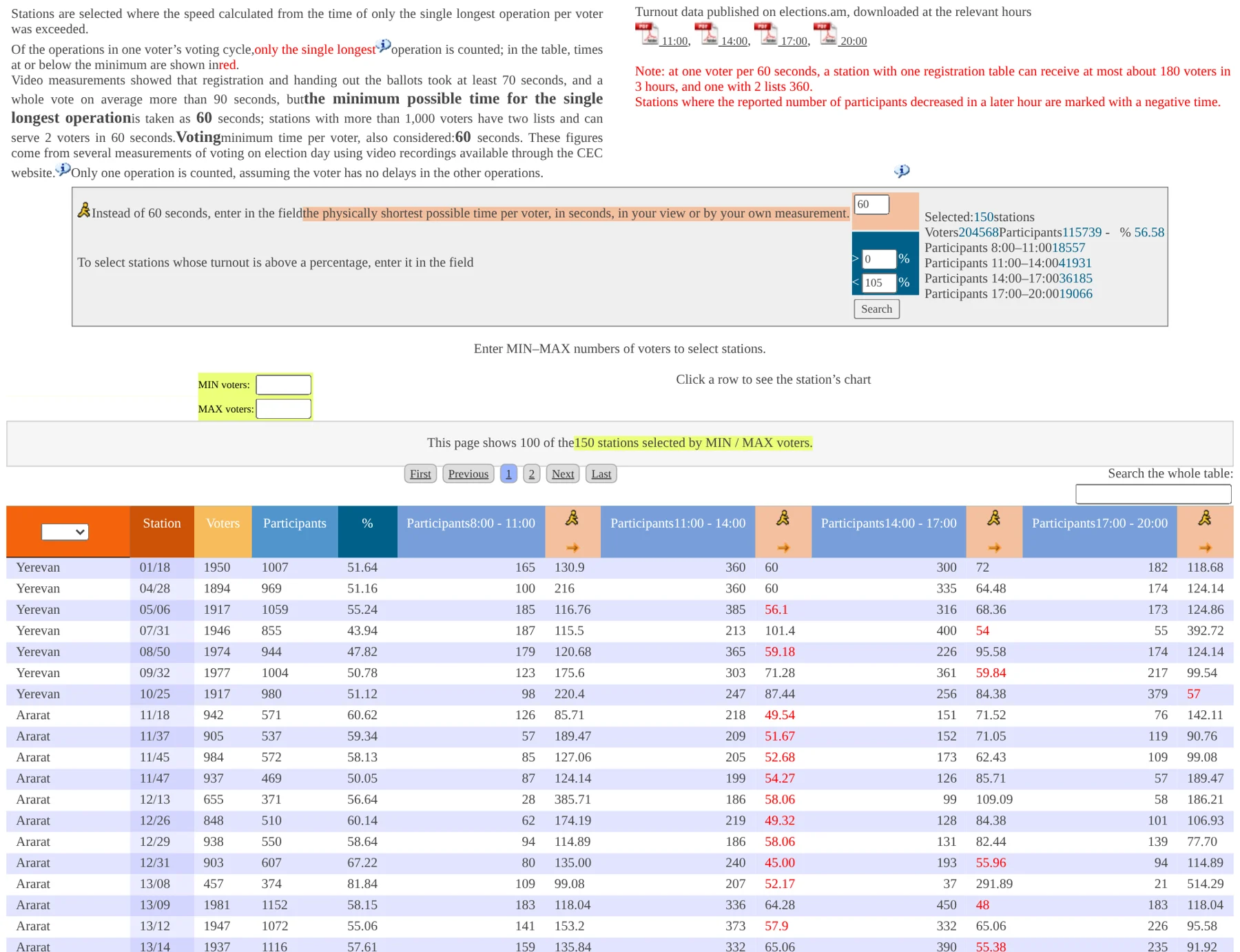
How to read this chart
- Left text: the method and the 60-second limit.
- Right text: links to the four official turnout reports (PDF) and the notes on capacity and negative turnout.
- Grey box: the limit in seconds (60) and a turnout range (> 0%, < 105%), and on the right the totals for the selected stations.
- Table: one row per station: province, station, voters, participants, turnout, then for each window the participants and the seconds per voter. Times at or below the limit are red. Click a row for the station’s chart. 100 rows are shown per page.
What it shows
150 stations with 204,568 voters and 115,739 participants were at 60 seconds or faster in at least one window. In 2017 the same limit selected 668.
Fewer and different stations
The 150 stations had 7.9% of the voters. Their turnout was 56.58%, against 47.95% at the other 1,860 stations. Most reached their fastest pace between 11:00 and 14:00 (104 stations).
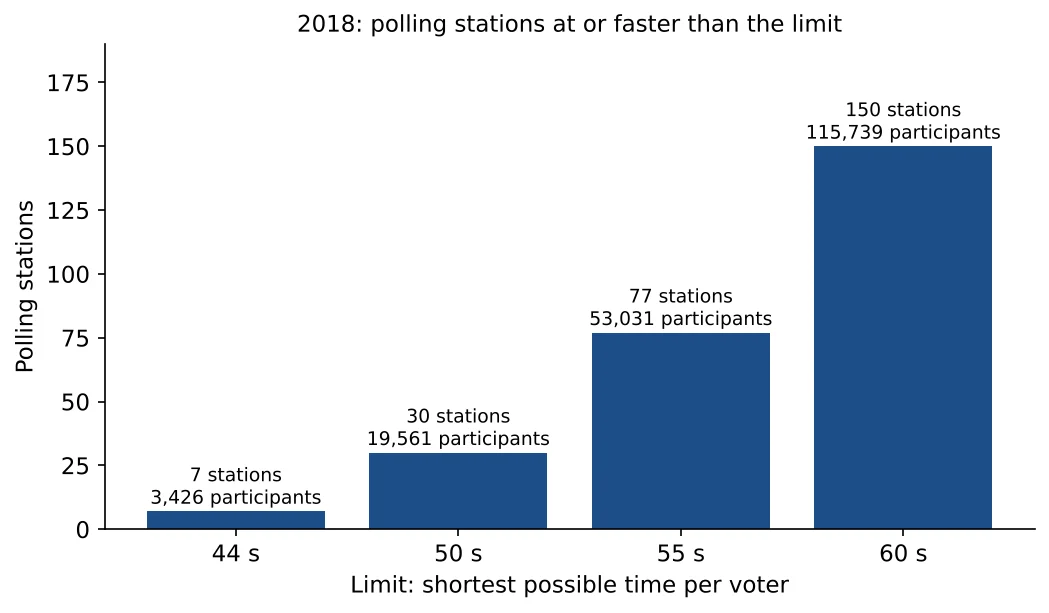
How to read this chart
Each bar is the number of stations the page lists for a limit, with their participants.
What it shows
At 44 seconds only 7 stations remain (3,426 participants); in 2017 there were 49, and in the 2015 referendum 107.
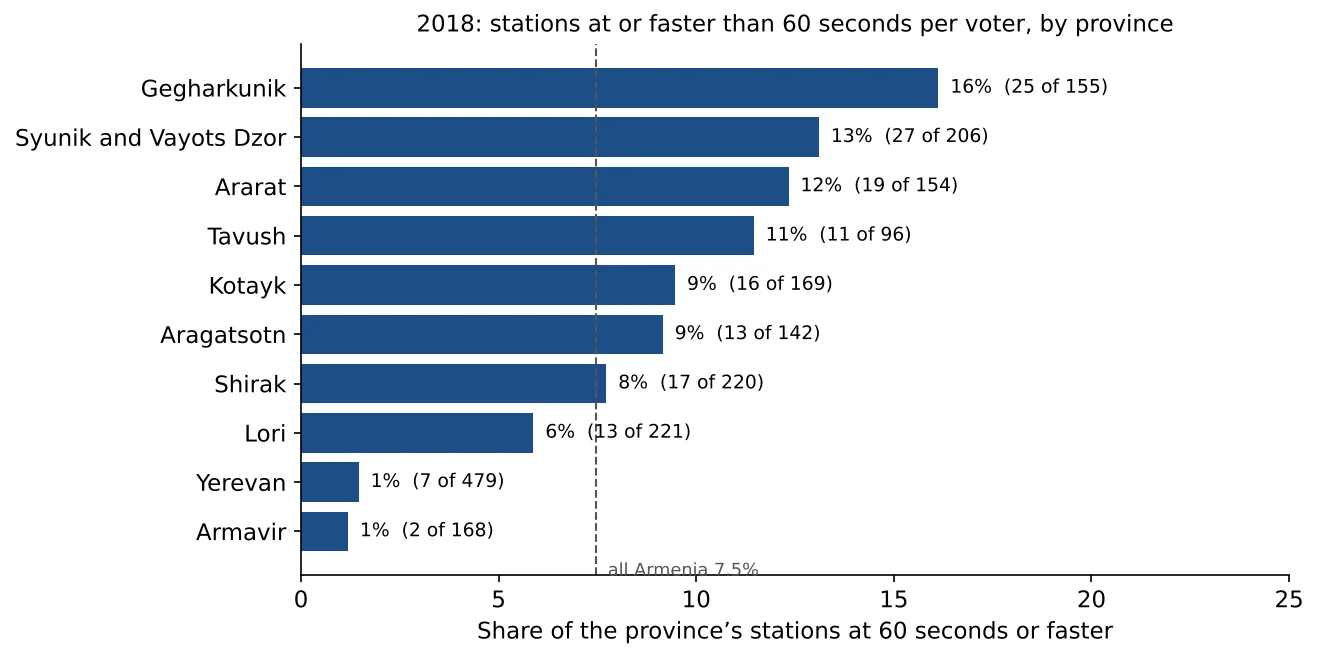
How to read this chart
Each bar is the share of the province’s stations on the list; in brackets the listed stations and all stations.
What it shows
Gegharkunik (25 of 155) and Ararat (19 of 154) lead again, as in 2017, but at a quarter of the 2017 level. In Yerevan only 7 of 479 stations are on the list.
The fastest stations and the voters added on election day
Four stations have impossible reports, with fewer participants at 20:00 than at 17:00: 23/18 in Vanadzor (−182), 36/13 in Rind (−166), 37/27 in Berkaber (−61) and 25/18 in Dzoramut (−20). Of the rest, the fastest are 20/52 Azat (Gegharkunik: 322 voters between 8:00 and 11:00 at one table, 33.54 seconds each, 87% turnout) and 34/73 Karashen (Syunik: 34.39 seconds). Both are among the stations whose voter lists grew sharply on election morning: Azat from 176 to 776 voters and Karashen from 418 to 890, see voter numbers on election day.
The 2017–2018 turnout and speed table
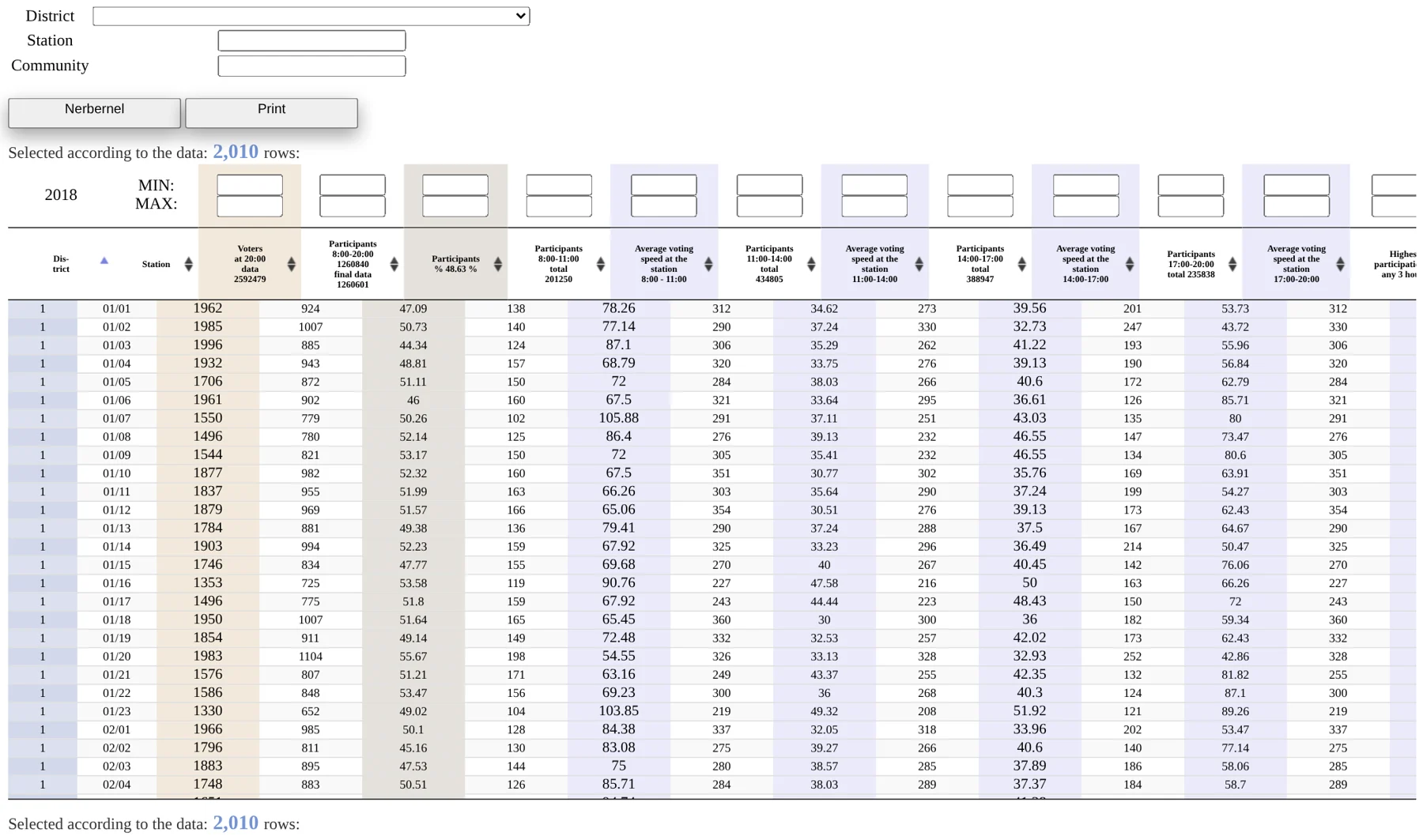
How to read this chart
The page “Turnout and voting speed at polling stations, 2017 and 2018” opens the full table for every station, with buttons for 2018 and 2017. Columns: district, station, voters at 20:00, participants, turnout, and for each window the participants and the average time per voter at the station; the last columns give the highest 3-hour participation and the shortest average time. The fields above each column filter it; Download and Print export the selection.
What it shows
Totals per window in 2018: 201,250 (8:00–11:00), 434,805, 388,947 and 235,838 (17:00–20:00). The same table, with 2021 added and in English, is explained in how to use the turnout and speed table.
The method: polling station capacity. Comparison by year: high-speed polling stations, 2012–2018.
Data and sources on this site
From the book
This article is based on Chapter VI of Electoral Rights and Election Falsification by Lyudvig Khachatryan, which explains the full method, the formulas and the cases behind it.